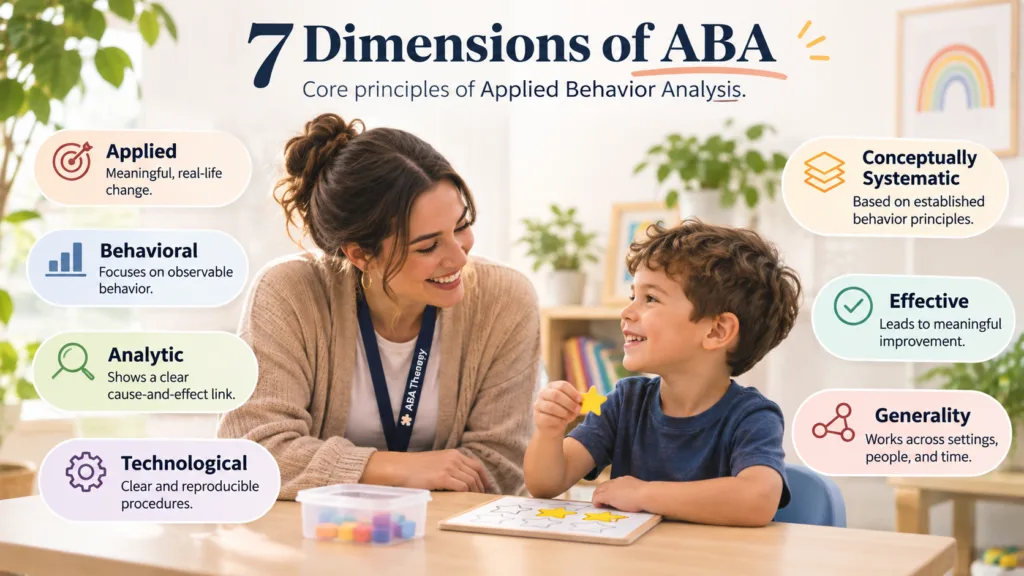
There are 7 dimensions of Applied Behavior Analysis (ABA): behavioral, applied, analytical, technological, conceptually systematic, effective and generality. Those are the characteristics of good ABA practice and are there to ensure that the interventions are in fact targeting real skills, that they are based on a clear approach, that the approach is scientifically based and that they do in fact lead to improved outcomes in the real world.
These dimensions give us a idea of what a good ABA program would look like. They tell you what it should contain and how each of the elements would contribute to the child’s learning.
What are the 7 dimensions of Applied Behavior Analysis?
The 7 dimensions were introduced in 1968 in an article by researchers Baer, Wolf, and Risley, “Some Current Dimensions of Applied Behavior Analysis.” Their framework helped explain why ABA is scientific and useful in real-life environments.
The 7 dimensions are not stages of therapy and they are not different forms of therapy. They are attributes which will inform the choice of goals, the design of the intervention, the measurement of progress and the analysis of the results in behavior analysis.
How to Remember the 7 Dimensions of ABA
An easy way to remember the seven dimensions of Applied Behavior Analysis (ABA) is through the mnemonic “GET A CAB.” Each letter represents one dimension: Generality, Effective, Technological, Applied, Conceptually Systematic, Analytic, and Behavioral.
This simple memory aid helps students, therapists, and parents recall the core principles of ABA and understand how they contribute to meaningful, measurable, and lasting behavior change.
Why These Dimensions of ABA Matter
Together they form the foundation for the meaningful, measurable and consistent application of ABA. They enable the practitioner to select appropriate targets, to specify precisely how they will achieve them and then to assess whether the intervention is in fact having the desired effect.
1. Applied: Focus on Meaningful Everyday Skills
The applied dimension is all about looking at the behaviors and skills that are relevant to the person’s day-to-day life. In ABA, these are often referred to as socially significant behaviors because they have a meaningful impact on the individual’s daily life. Goals are chosen in partnership with the individual and family and are those that they feel will result in an improvement in independence, communication, participation and quality of life.
Real-life example:
Imagine a child who has difficult asking for help with dressing. The therapist doesn’t just pick a goal on the basis of how easy it is to teach. The therapist works with the family to get the child to communicate when they need help.
This skill is absolutely essential as it enables the child to be independent at home and in other settings. The aim is very realistic and it’s exactly what the family want.
2. Behavioral – Define and Measure Observable Behavior
The behavioral dimension of ABA is all about behavior that is observable and measurable. Clear definitions are absolutely essential in order that everyone knows what the target behavior is and how progress is going to be measured. In ABA, this is known as an operational definition, which allows different practitioners to identify and measure the same behavior consistently.
That doesn’t mean thoughts and feelings aren’t important. If a child is telling you that they are uncomfortable, worried or frustrated then that needs to be taken into account. The expert can of course take into account the relevant observations and information as well as the self report.
Real-life example:
This could be an ambiguous objective such as “be more respectful”. A more specific objective would be “Request to take a turn (either verbally, with gestures or via a communication device) in a shared activity”.
3. Analytic: Demonstrate that an Intervention Made a Difference
The ‘analytical’ side of ABA is about using the data and the appropriate evaluation methods to demonstrate a change as a result of the intervention. A change during therapy does not necessarily prove that the intervention caused it. There are all sorts of other things that can affect behavior (e.g. changes in the home or school environment).
Real-life example:
A child making an independent request for help in the course of an activity is noted. Following the introduction of the teaching strategy the child makes more independent requests.
This information is useful, of course the therapist would have to look at the patterns over time and work to rule out any other possible explanation for the improvement before they could say that the intervention was in any way the cause. That would also give us a chance to look at how we might go about dealing with certain types of issues.
4. Technological: Describe Procedures in a Way that Can be Repeated
In the technological dimension of ABA, the intervention procedures are written very clearly and adequately so that a trained interventionist can implement them in a consistent way. That doesn’t include the use of computers, tablets or any other electronic device.
Real-life example:
A teaching plan for helping a child request assistance with a puzzle can contain details on how to introduce the activity, when to provide prompts, what to reinforce, and how independent requests are to be recorded.
Directional prompts help get the various members of the team moving in the same direction and let them know when it’s time to make a change.
5. Conceptually Systematic: Use Behavioral Principles
Being conceptually systematic in ABA is also very helpful. ABA strategies need to be related to or derived from known principles of behavior, not be a set of unrelated techniques.
Reinforcement is a consequence which makes a behavior more likely to occur again.
Real-life example:
A child is learning to ask for their favorite toy. The toy will be given if they ask for it. That consequence leads to more requests in the future. This is an example of positive reinforcement.
The strategy is based on a very simple behavioral principle rather than simply doing the same thing over and over again without any real understanding of why it might work.
6. Effective: Make a Useful and Practical Improvement
The effective dimension of ABA is another crucial one. It has to be an effective intervention in some meaningful way rather than simply producing a small numerical improvement. The outcomes have to be relevant to the learner’s world.
The caregiver’s comfort, their preferences and input and the child’s own quality of life must be taken into account. The goals must be appropriate and respectful and should not be based on coercion or be aimed at eradicating the benign differences.
Real-life example:
Child asks for a break when it’s too much. The child doesn’t need to carry on any longer, they can just say they need a break.
This is significant progress in that it enables communication, choice and participation.
7. Generality: Make Skills Last and Transfer Across Settings
Generality in ABA is the ability of the skill to be maintained over time, across different people, different places and different situations. A skill is not generalized if it’s only demonstrated in one therapy session and the child is then unable to use it in a natural way in other areas.
Real-life example:
Child learns to ask for help from a therapist. The team then work with the child in practice sessions with parents, teachers, and other familiar individuals (all the people the child is used to interacting with). The child then generalizes the skill to home and school in the absence of the original teaching situation.
This is the skill being applied in the real world.
How the 7 Dimensions of ABA Are Used Together
Think of the child learning to ask for help. The goal is applied because it promotes independence. It’s a behavioral approach as you can see the requests and measure them. The therapist will use the data to assess the efficacy of the teaching. That’s the analytic element.
The teaching procedures are extremely well written and are very much of a technological nature. The approach is conceptually sound in that it is predicated on behavioral principles. The intervention is effective if it makes a meaningful difference to the child’s day-to-day life. The child’s use of the skill has to be demonstrated with a range of people and in a range of settings to demonstrate generality.
Comparison of 7 dimensions
The table below is a quick comparison of the 7 Dimensions:
| Dimension | Meaning | Short Example |
| Applied | Focus on useful skills | Asking for help |
| Behavioral | Clear actions measurement | Count independent requests |
| Analytical | To determine the reason for change. | Review data about the interventions that have occurred. |
| Technological | Explain steps clearly. | Write a teaching plan. |
| Conceptually Systematic | Apply behavioral principles. | Use reinforcement. |
| Effective | Make meaningful progress. | Communicate a need for a break. |
| Generality | Use skills in real activities. | Ask for assistance at home/school. |
Frequently Asked Questions
Who came up with the 7 Dimensions of ABA?
The 7 dimensions were first published in 1968 in an article by Baer, Wolf and Risley titled ‘Some Current Dimensions of Applied Behavior Analysis’.
Is there any connection between the 7 Dimensions and the 7 Steps of ABA?
No the dimensions are the hallmarks of good ABA practice. They don’t have to be the steps of the therapy.
What Happens When an ABA Intervention Is Not Effective?
When an ABA intervention is not producing meaningful progress, the practitioner reviews the data, consults the learner and family, and identifies possible barriers. The intervention may then be modified to better meet the individual’s needs.
Conclusion
The 7 dimensions of ABA provide a ‘family/practitioner’ view of what ABA is, what it means and what it can do. Parents should be looking for progress that improves the child’s day to day life rather than using the dimensions as a checklist. When discussing therapy goals with the team at Brightsteps ABA, parents can use these dimensions to understand why particular skills are being taught, how progress is measured, and whether their child can use those skills independently outside therapy sessions