
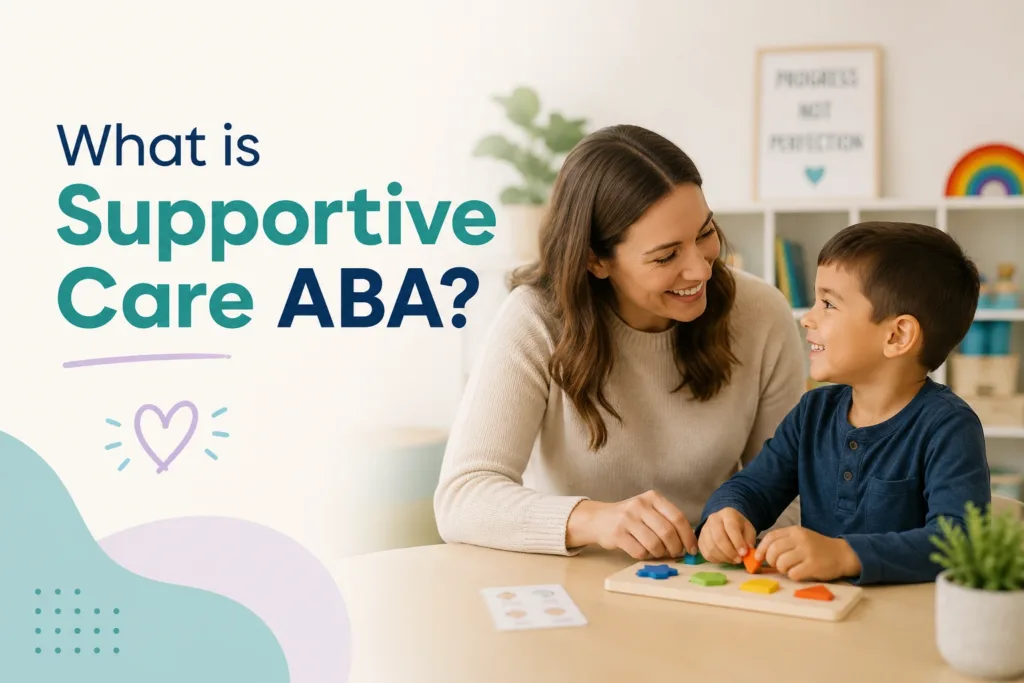
It seems that everything becomes difficult once parents hear about their kids being autistic. This is because they are trying to determine how their children should relate to the world around them. Ways to ensure they have proper communication, independence, and social skills.
That is where Supportive care ABA comes in. Supportive care ABA is an individualized, scientifically proven method of autistic therapy. In fact, it integrates the best approaches from ABA therapy with a family-oriented treatment approach, unlike conventional ABA.
In contrast, supportive care aims to teach children useful skills for their entire lives. The key point of this therapy is to help children not just acquire new skills but also learn to apply them.
To understand the advantages of the new method, it is necessary to become acquainted with scientific data on ABA evolution and treatment methods.
Understanding Supportive Care ABA
The principles of Supportive Care ABA rest on the same scientific basis as conventional ABA treatment; however, they provide more personalized and practical assistance.

Applied Behavior Analysis is an area of behavioral science dedicated to researching the mechanisms underlying learning processes and to influencing behavior through environmental stimuli.
The Applied Behavior Analysis therapy is the most studied and implemented therapeutic method to assist children having difficulties with ASD for many years. This approach has been acknowledged as an evidence-based intervention to help with autism by the American Psychological Association and the U.S. Surgeon General.
One of the first studies in the field of ABA, conducted in 1987, was by Dr. O. Ivar Lovaas. His findings showed that children receiving intensive behavioral treatment were significantly more likely to improve in language acquisition and learning than those receiving little to no treatment.
Despite the numerous studies supporting the efficacy of ABA, its application has undergone many changes through time.
In the modern world, people seek therapy that seems natural and relevant to their lives. Supportive care ABA reflects this change. It not only teaches skills but also focuses on understanding why a behavior is happening and how a child can communicate better in that moment.
Instead of only asking, “How do we stop this behavior?” therapists also think about:
- What is the child trying to say?
- What skill is missing?
- How can we help the child succeed in daily life?
This approach makes therapy more meaningful and more supportive for both children and families.
How Supportive Care ABA Works in Real Life
Every child is different, so supportive care ABA always begins by understanding the child as an individual.
Step one involves a comprehensive evaluation conducted by a Board Certified Behavior Analyst (BCBA). This includes an analysis of several domains, such as communication skills, social skills, self-care ability, learning modality, and behaviors that may interfere with day-to-day functioning.
This evaluation is not limited to a single domain but aims to gain a holistic picture of the child’s needs and strengths.
Based on this evaluation, the BCBA formulates individualized treatment objectives that are functional and practical for improving the child’s communication, emotional regulation, independence, socialization, and overall self-regulation.
Following up on the plan’s development, the registered behavior technicians (RBTs) assist the child during therapy sessions, provide training and coaching, and monitor their progress at each stage.
Data collection is one of the key aspects of the ABA therapy process, since conclusions.
If the child is performing well, they can move forward to establishing new goals. Otherwise, they should adjust the failed ones. This makes the whole therapy process more goal-oriented and efficient.
Therapy Methods Used in Supportive Care ABA
Supportive Care ABA employs both structured and natural interventions to help children acquire skills like communication and independence.
Discrete Trial Training (DTT)
In discrete trial training, the skills are broken down into more easily manageable tasks. The therapist gives an instruction, the child carries it out, and then reinforcement follows.
The method is primarily used to teach fundamental skills such as object identification, task completion, and communication.
Natural Environment Teaching (NET)
The process entails learning to perform the task naturally through activities such as playing and eating. In such a scenario, a child can learn to make requests for a specific plaything while playing or to seek help during a specific activity.
Task Analysis
At first, some assignments may seem too overwhelming or even unmanageable. But in this case, task analysis can play a crucial role in overcoming such hurdles. The task analysis approach entails breaking a task into smaller parts and going through each step.
Task analysis is considerable when performing any ordinary task, such as washing hands, dressing, or brushing your teeth. During such activities, a kid gradually gains experience in accomplishing a whole sequence, starting from analyzing its stages.
Positive Reinforcement
This type of reinforcement occurs when an action is rewarded immediately after it occurs. Positive reinforcement could consist of compliments, activities, and even objects that would cause happiness within the child.
Positive reinforcement works really well because it teaches the child about good actions and motivates him or her to repeat them.
Prompting and Fading
Prompting refers to providing help so the child can learn to do things, verbally, physically, or through different approaches. Slowly but surely, though, prompting decreases until the child becomes able to do things independently.
Core Principles Behind Supportive Care ABA
Supportive care ABA is built on three main principles that connect science with real-life therapy.
Evidence-Based Treatment
Every strategy used in ABA is based on scientific research. It is supported by major organizations like the APA and the U.S. Surgeon General. Children who receive ABA from an early age gain many benefits in their communication abilities, learning, and personal care. This ensures therapy is based on proven methods.
Individualization
Autistic children are all different. This is one reason why therapy is always individualized for the child, taking into account his strengths, weaknesses, and preferred learning styles.
Family Involvement
Parents and cares are extremely important to therapy. Scientific research shows that children benefit when they repeat their therapy exercises at home as well as in therapy sessions.
That is why families receive therapy training too. This helps children use their skills more effectively in real life.
Skills Developed in Supportive Care ABA
ABA in supportive care focuses on skills that make daily living easier. One of the first things talked about in this context is communication. Many children cannot express their needs effectively, and the aim of the therapy is to enable them to communicate using verbal speech, gestures, and assisted forms of communication.
Another big part is social skills, sort of, learning how to take turns, answer or react to other people, and manage themselves appropriately while in a group setting.
Then there are daily living skills, like getting dressed, brushing one’s teeth, and eating without help. According to scientific evidence, development in these areas promotes independence.
Advantages of Supportive Care ABA
Supportive Care ABA offers many meaningful benefits when used consistently. One of the biggest improvements is communication. Frustration levels tend to lower when children find it easier to express their feelings.
According to the findings, ABA may help reduce disruptive behaviors. The results of an experiment reported in the Journal of Applied Behavior Analysis revealed that communication training typically reduces instances of disruptive behavior, such as tantrums and aggression.
The level of emotion control improves. It becomes easier for them to deal with changes, cope with frustration, and react to various stimuli. These skills help achieve success in everyday activities, including school and home life.
Why Family Involvement Matters
Family involvement plays a major role in children’s learning success during ABA therapy.
Supportive care ABA involves training caregivers to help parents promote learning at home. Consistent implementation of the same strategies by families results in accelerated, improved retention of skills learned by children.
This also ensures that the skills learned are transferable across other settings, which is extremely vital for success.
Where Supportive Care ABA is Delivered
Supportive care ABA can take place in different settings depending on the child’s needs. Home-based therapy enables the child to learn in the environment where they feel comfortable. Therapy in clinics provides structure and limited distraction for the child.
On the other hand, school and community-based therapy enable children to learn practical skills. This enables the development of a holistic approach in therapy.
| Setting | What it Looks Like | Why it Helps |
| Home-Based Therapy | Therapy happens at home during daily routines. | Builds skills in a natural, familiar environment. |
| Clinic-Based Therapy | Sessions take place in a structured clinic. | Supports focused learning with fewer distractions. |
| School-Based Support | Therapy is provided in school settings. | Helps apply skills in academic and social situations. |
| Community-Based Support | Learning happens in places like parks or stores. | Builds real-world independence and confidence. |
What Makes Supportive Care ABA Different
Supportive care ABA is unique since it integrates both rigid and flexible elements. The scientific principles of ABA remain, but the primary emphasis lies on comfort, natural learning, and the involvement of the family members.
It emphasizes skill acquisition to improve independence rather than reducing problematic behaviors.
How BrightSteps ABA Delivers Supportive Care ABA
At BrightSteps ABA, Supportive Care ABA is offered through personalized therapy plans that are designed around each child’s unique needs. Every program is created by a Board Certified Behavior Analyst (BCBA) and delivered by trained therapists who work closely with parents every step of the way.
The main focus is real progress that families can see in daily life, better communication, more independence, and stronger overall functioning. BrightSteps ABA also ensures strategies remain consistent at home, in therapy, and in the community so children can continue building skills with confidence.
If you’re looking for supportive, guided ABA care for your child, BrightSteps ABA is here to help you take the next step forward.
Conclusion
Supportive care ABA is an attempt to achieve balance in providing treatment for autism by focusing on practical outcomes rather than knowledge gained through the sessions. The inclusion of effective behavioral approaches with tailored attention enables the teaching of skills that will be helpful to the child later in life.
Practice will improve communication, independence, social skills, and competence in performing daily activities. All of this, together with help from the parents, will become quite easy.
For the families of autistic kids, this approach is an effective way to make further steps toward achieving tangible and realistic results.
References: