
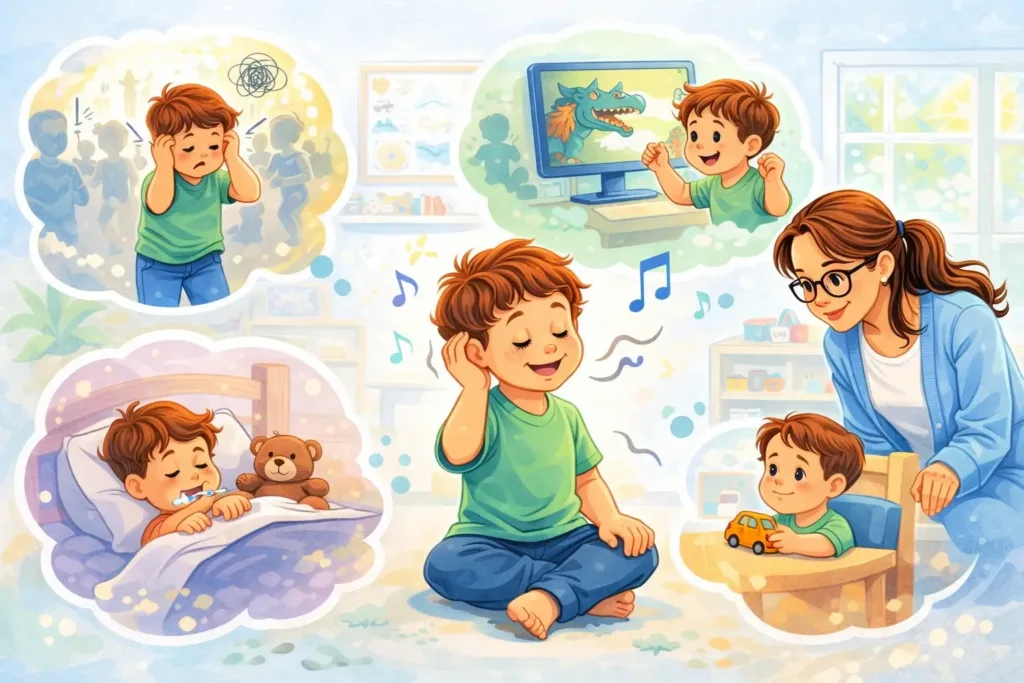
If your child makes repetitive sounds, hums often, repeats words or phrases, or seems to “get stuck” on certain noises, you may have come across the term vocal stimming. For many parents, this can be confusing at first. Is it a communication issue? A sensory behavior? A sign of stress? Something that needs to be stopped?
The answer is often more nuanced than a simple yes or no. Vocal stimming in autism usually serves a purpose. It can help a child regulate emotions, manage sensory input, express excitement, cope with anxiety, or fill moments that feel overwhelming or under-stimulating. Rather than viewing it as just a behavior to eliminate, it is often more helpful to understand what the child may be getting from it and how to support them in a respectful, practical way.
This article explains what vocal stimming can sound like, why it happens, when it is usually harmless, and when extra support may be helpful.
What Is Vocal Stimming?
Vocal stimming refers to repetitive sounds, noises, words, or vocal patterns. Some children hum, squeal, click their tongue, repeat the same phrase, sing short lines from songs, or make sound effects again and again. Others may use repeated movie lines, familiar scripts, or unusual vocal patterns that seem disconnected from the immediate situation.
These sounds may happen quietly or loudly, briefly or for long periods, and they may increase in certain settings or emotional states. For one child, it may sound like humming during play. For another, it may involve repeating a phrase over and over when excited or overwhelmed.
Vocal stimming is often discussed in relation to autism, but it is important to remember that not every repetitive vocal behavior automatically means autism. Context matters, and the overall developmental picture matters too.
Vocal Stimming vs. Echolalia vs. Scripting
These terms can overlap, which is why they are often confusing for families.
Vocal stimming is the broad idea of repeated vocal patterns or sounds.
Echolalia usually refers to repeating words or phrases that someone else has said.
Scripting often refers to repeating stored phrases from shows, videos, songs, or past conversations.
A child may use echolalia or scripting as part of vocal stimming, but sometimes those repeated phrases are also a form of communication. That is why it is helpful to look closely at what the child may be trying to do, express, or regulate.
What Vocal Stimming Can Sound Like
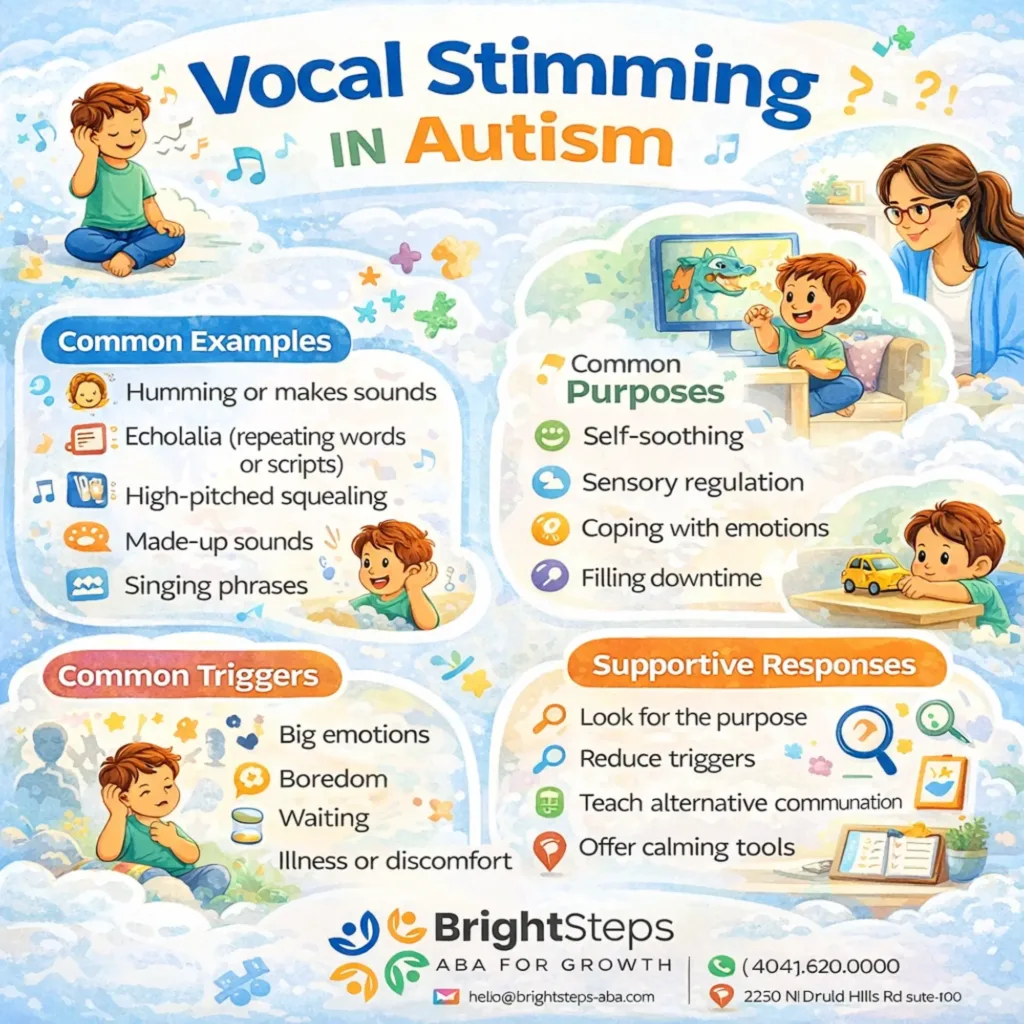
Vocal stimming can sound different from child to child. Some of the more common examples include humming, squealing, repeated grunting, high-pitched noises, repeating one word many times, reciting lines from a favorite show, making animal sounds, singing the same tune repeatedly, or using made-up sounds during play.
To a parent, teacher, or sibling, these sounds may seem random. But for the child, they are often serving a purpose. The sound itself may feel calming, enjoyable, organizing, or expressive. The more we understand that function, the better we can respond.
Why Vocal Stimming Happens
One of the most important things to understand is that vocal stimming often meets a need. It is rarely just “noise for no reason.” In many cases, it helps the child regulate themselves in some way.
For some children, vocal stimming is soothing. The sound and repetition may help lower stress or create a sense of predictability. For others, it provides sensory input. The child may enjoy how the sound feels in their body, ears, or mouth. Some children vocal stim when they are bored or under-stimulated, while others do it during excitement, anticipation, or joy.
Vocal stimming can also increase during anxiety, frustration, fatigue, or transitions. If words are hard to find or emotions are big, the repeated sound may become a way to release tension or stay organized.
It Can Be Joyful, Not Just Stress-Based
Parents sometimes assume that all stimming means distress, but that is not always the case. Vocal stimming can absolutely happen during happiness and excitement. A child may hum during favorite activities, repeat a phrase they love, or squeal during play because they feel delighted and engaged.
This matters because it changes the way we interpret the behavior. If we assume every vocal stim is a problem, we may overlook the fact that the child is actually enjoying themselves or using a harmless way to stay regulated.
Common Triggers for Vocal Stimming
Although every child is different, there are a few common patterns families often notice.
Sensory overload is a big one. Loud rooms, bright lights, crowded spaces, and busy environments can increase vocal stimming because the child is trying to manage too much input.
Big emotions can also trigger it. Excitement, anxiety, frustration, disappointment, and anticipation can all lead to more repetitive vocal behavior.
Understimulation is another possibility. During waiting periods, long car rides, quiet times, or transitions, a child may vocal stim simply because the repetition helps keep them regulated and engaged.
Sometimes sudden increases in vocal stimming can also point to discomfort, fatigue, illness, or pain. If a child cannot easily explain what hurts or feels wrong, their behavior may shift before adults understand why.
When Vocal Stimming Is Usually Harmless
Many forms of vocal stimming are not dangerous and do not need to be “fixed.” If the child is safe, the vocalizing is not causing major problems, and it seems to help them stay regulated, the most supportive response may simply be understanding it better.
This can be hard for families, especially when the sounds are repetitive or loud. But harmless vocal stimming is often part of how a child manages their body and emotions. In those moments, the goal may not be stopping it. The goal may be helping the child feel safe and supported while also considering the needs of the environment.
This is especially important because children pick up quickly when adults are embarrassed by them. If a harmless stim is constantly corrected, the child may feel ashamed without actually learning a better way to meet the same need.
When Vocal Stimming May Need Extra Support
There are times when vocal stimming may need more attention. The concern is usually not that the child is making sounds, but that the sounds are interfering significantly with daily life.
For example, extra support may be needed if vocal stimming keeps the child from sleeping, takes over most of the day, replaces functional communication too often, disrupts learning in a major way, or suddenly increases in intensity. It may also need a closer look if it seems closely tied to distress, pain, or emotional overload.
This is where the question changes from “How do I stop this?” to “What is happening, and what support does my child need?”
Vocal Stimming in the Classroom
The classroom is one place where vocal stimming can become especially complicated. Teachers may be concerned about distraction. Peers may notice the sounds. The child themselves may be dealing with stress, sensory overload, or communication difficulty that makes the vocalizing more likely.
Support in the classroom should focus on understanding triggers, making reasonable accommodations, and helping the child regulate. Punishment or repeated shushing usually does not solve the underlying problem. If the child is overwhelmed, they need support, not just correction.
How to Respond Supportively at Home
One of the most helpful things parents can do is pause before reacting. Instead of assuming the sound is “bad behavior,” try to look for the pattern.
What was happening right before it started? Does it happen more when your child is tired, waiting, excited, or stressed? Does it happen in noisy places or during quiet downtime? Does it decrease when they get movement, comfort, or help?
These questions help you figure out the function. Once that becomes clearer, you can respond more effectively.
Reducing triggers can help in some cases. That might mean softening noise, adjusting routines, lowering demands during overwhelm, or creating more predictability during transitions.
It can also help to teach more functional communication when needed. If vocal stimming spikes because your child wants a break, needs help, feels overstimulated, or is trying to avoid something difficult, teaching those communication skills may reduce the need for the vocal behavior to do all the work.
At the same time, it is important to offer other regulation tools without shame. Some children benefit from movement breaks, music, sensory activities, quieter spaces, or calming routines. These are not meant to erase the child’s personality. They are meant to widen the child’s toolbox.
Families matter in this picture too. If the noise level is exhausting for caregivers or siblings, that does not make anyone a bad person. It is okay to acknowledge household stress and create routines that support everyone.
Should You Try to Stop Vocal Stimming?
In many cases, the best answer is not “stop it,” but “understand it.” If the vocal stimming is harmless and regulating, eliminating it may not be necessary or helpful.
If the vocalizing is intense or interfering, the goal should still not be simple silence. A better goal is to understand the need behind it and help the child meet that need in a way that works more comfortably across settings.
Replacement Behavior for Vocal Stimming
A replacement behavior only makes sense if it meets the same need. If a child hums to stay calm, a replacement needs to help with calming too. If they vocalize when they need a break, the replacement may be learning how to ask for one.
Possible alternatives might include requesting a break, using a quieter form of sound, building in intentional music or vocal time, adding movement breaks, or teaching a communication tool that helps them express discomfort more clearly.
The key is that the replacement should help, not just suppress.
Vocal Stimming, ADHD, and “Not Autism”
Some families wonder whether vocal stimming always means autism. The answer is no. Repetitive vocal behaviors can appear in other neurodevelopmental profiles too, including ADHD, and sometimes even in children without a diagnosis.
What makes the autism conversation different is that vocal stimming often appears alongside broader patterns involving sensory regulation, communication differences, social challenges, and other repetitive behaviors. That is why the whole child matters more than any one behavior.
How ABA Therapy Can Help
When vocal stimming becomes confusing, disruptive, or hard for families to manage, a thoughtful clinical approach can help. ABA Therapy can be useful because it looks at behavior in context. Instead of assuming the sound itself is the problem, it asks what the sound is doing for the child.
That may mean identifying whether the vocalizing is tied to sensory input, escape, stress relief, attention, excitement, or communication. Once the function is clearer, support can be more individualized and respectful.
At Bright Steps ABA, we work with families to understand behaviors in the context of the whole child, not just the moment they become noticeable or difficult. Our team focuses on meaningful progress, communication, and daily-life comfort so that support feels practical, compassionate, and grounded in what children and families truly need.
What Parents Often Ask
Many parents ask, “How do I stop the constant noise?” Usually, that question comes from exhaustion, not a lack of love. The most helpful place to start is not with stopping, but with understanding.
Parents also ask why vocal stimming sometimes gets worse suddenly. Often the answer lies in stress, routine changes, illness, fatigue, or overwhelm.
Another common question is whether children outgrow it. Some do show changes over time. The vocal stimming may lessen, shift, or become more context-based. But the bigger goal is not always to outgrow it. The bigger goal is to help the child communicate, regulate, and function more comfortably.
FAQs
What is vocal stimming in autism?
Vocal stimming refers to repetitive sounds, noises, words, or phrases used for self-regulation, sensory input, excitement, or stress relief.
Why do autistic children vocal stim?
They may vocal stim to soothe themselves, manage sensory input, express big emotions, cope with boredom, or regulate during stressful or exciting moments.
How to stop vocal stimming in autism?
The first step is understanding why it happens. Support should focus on triggers, communication, regulation, and alternatives when needed rather than trying to silence it automatically.
What is a replacement behavior for vocal stimming?
A replacement behavior should meet the same need, such as asking for a break, using another calming tool, getting movement, or using a more functional form of communication.
Is vocal stimming always autism?
No. Repetitive vocal behaviors can also appear in other neurodevelopmental profiles or even in children without autism.
Is echolalia the same as vocal stimming?
They can overlap, but echolalia usually refers to repeating words or phrases heard from others, while vocal stimming is a broader term for repeated sounds or vocal patterns.
What causes vocal stimming to get worse?
Common causes include stress, sensory overload, excitement, fatigue, illness, pain, and changes in routine.
How can teachers handle vocal stimming in the classroom?
Teachers can look for triggers, offer sensory and communication supports, use realistic accommodations, and avoid punishment-based responses.
Can adults have vocal stimming too?
Yes. Vocal stimming can continue into adolescence and adulthood, though it may change in form or intensity over time.
When should I seek help for vocal stimming?
It may be helpful to seek support if the vocalizing is causing distress, interfering heavily with sleep or learning, replacing communication too often, or changing suddenly in intensity.