
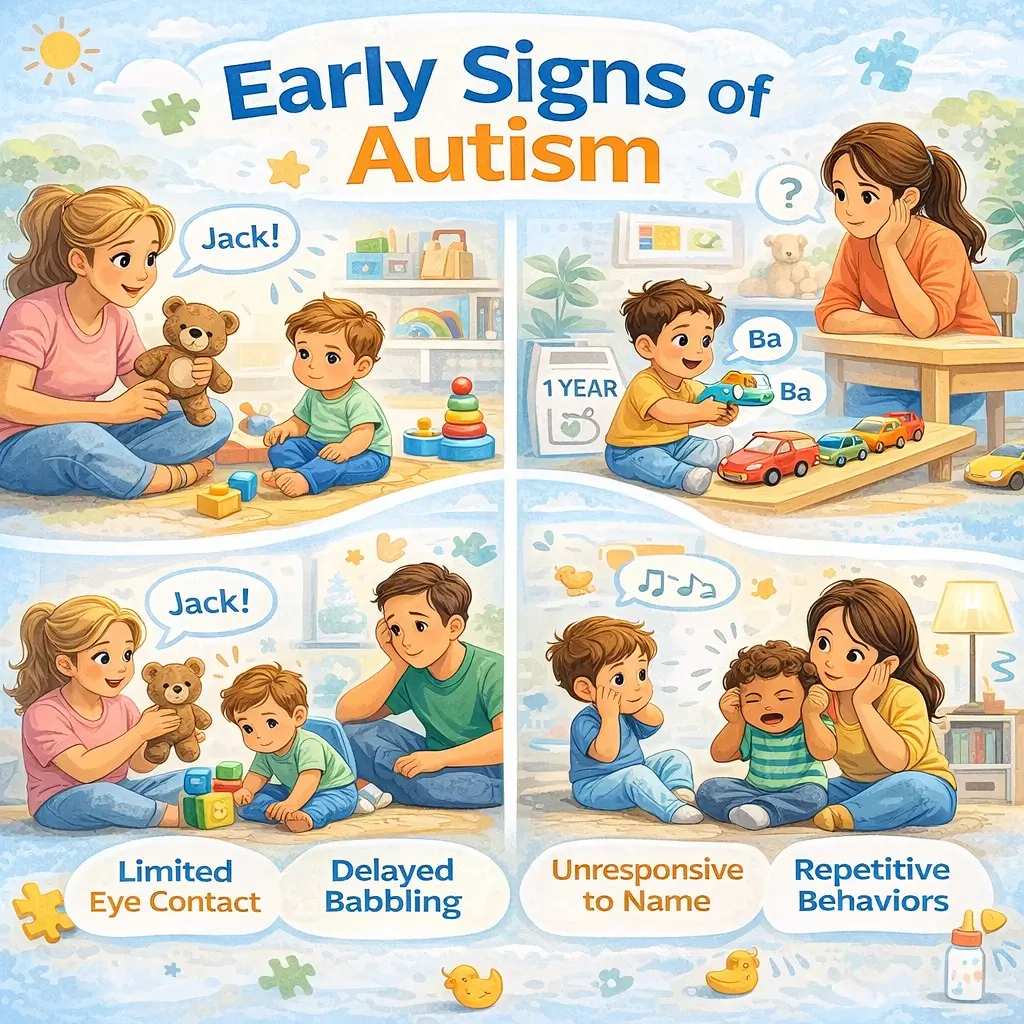
Noticing something different about your child can bring up a mix of emotions—curiosity, concern, and sometimes uncertainty about what to do next. Many parents begin by asking simple questions: Why isn’t my child responding to their name? Why do they seem less interested in people? Why are certain behaviors repeating?
Understanding the early signs of autism can help you make sense of these observations in a calm and informed way. Autism is not defined by one behavior. It is usually a pattern of differences in social communication, interaction, and behavior that appear over time. Some children show signs within the first year, while for others, the differences become clearer during toddlerhood.
The goal of recognizing early signs is not to label too quickly, but to understand your child better and know when it may be helpful to seek support.
What Are the Early Signs of Autism?
Early signs of autism often fall into three main areas: social connection and communication, play and interaction, and patterns of behavior or sensory responses. These signs can vary widely from child to child, which is why it is important to look at the overall pattern rather than focusing on a single behavior.
A child may have difficulty with back-and-forth interaction, show less interest in shared activities, or communicate differently than expected for their age. They may also engage in repetitive behaviors, prefer routines, or react strongly to certain sounds, textures, or changes in their environment.
It is important to remember that all children develop at their own pace. However, when multiple differences appear together and continue over time, they may point toward the need for further evaluation.
Early Signs of Autism by Age
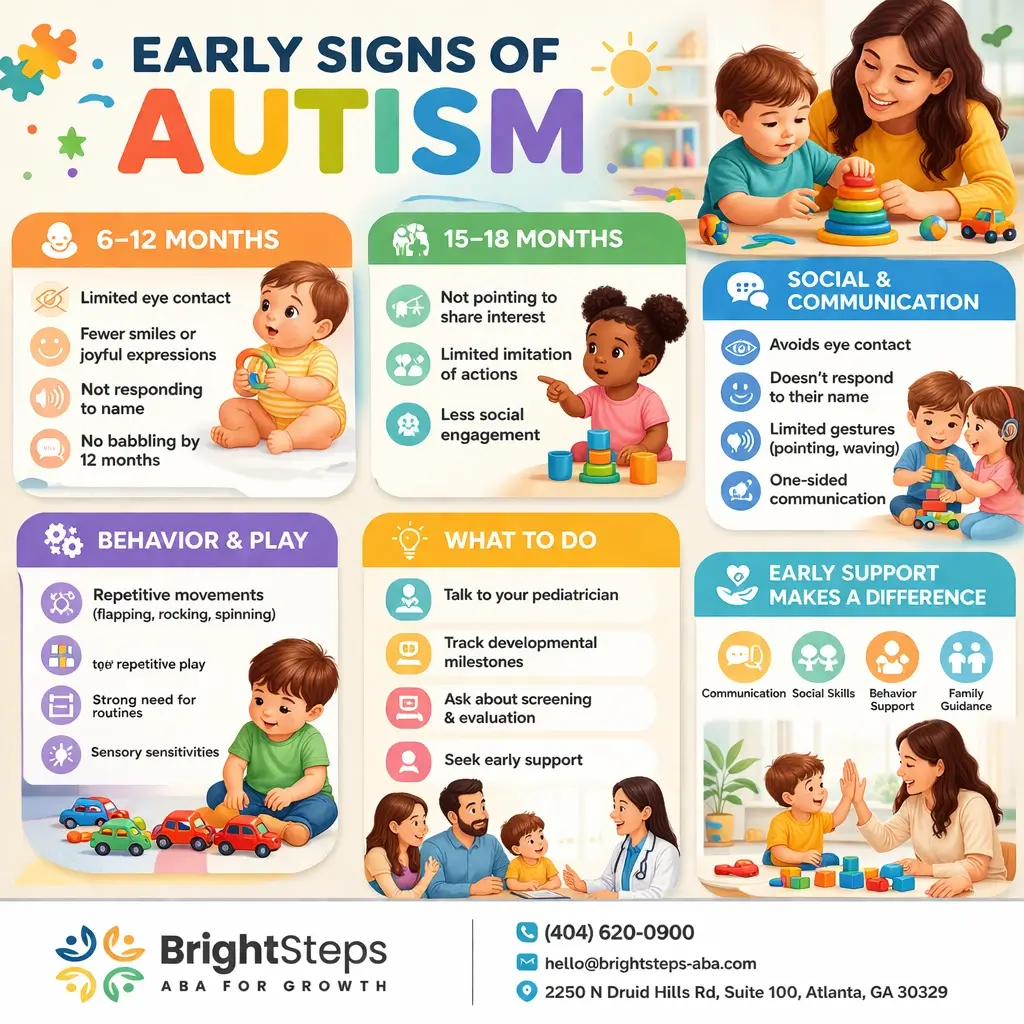
Recognizing signs by age can make it easier for parents to understand what to look for during different stages of development.
Around 6 Months
At this stage, many babies begin to show strong social engagement through smiles, eye contact, and joyful expressions. A potential early sign may be fewer smiles or limited eye contact. A baby might seem less responsive to faces or less interested in shared interaction.
Around 9 Months
By this age, babies often begin to engage in back-and-forth exchanges, such as smiling, making sounds, and responding to others. A child who shows limited sharing of sounds or facial expressions may stand out. They may seem less engaged during interaction or less likely to respond socially.
Around 12 Months
At one year, communication typically begins to expand. Most children respond to their name, babble regularly, and use gestures like pointing or waving. Early signs may include not responding consistently to their name, limited or no babbling, and fewer gestures used to communicate needs or interest.
Around 15 to 18 Months
This stage often includes increased curiosity and social sharing. Children may point to show things they like, imitate simple actions, and engage in early pretend play. A child who does not point to share interest, rarely imitates others, or shows limited engagement in simple play may need closer observation.
Around 24 Months
By age two, many children begin using two-word phrases and show more complex social interaction. Early signs at this stage may include limited spoken language, loss of previously used words or skills, or more noticeable repetitive behaviors and strong preferences for routines.
Social and Communication Signs Parents Often Notice
One of the earliest areas where parents notice differences is communication. This does not always mean a child cannot communicate, but rather that they communicate in different ways.
A child may avoid or reduce eye contact, seem not to respond when their name is called, or show less interest in sharing experiences. They may not point to objects to show interest or bring items to others to share attention. Conversations, even simple ones, may feel one-sided or difficult to start.
Some children may develop speech later than expected, while others may develop speech but use it differently. For example, they may repeat phrases, use language in a very literal way, or struggle with back-and-forth conversation.
How to Tell if a Baby Has Autism
Parents often ask how early autism can be identified. The truth is that babies are not diagnosed based on one behavior alone. What matters is a consistent pattern of differences across social interaction, communication, and behavior over time.
If you notice that your baby is less engaged, does not respond to familiar voices, or shows limited communication attempts, it may be worth discussing with a pediatrician. Trusting your instincts is important, especially if something feels consistently different.
Behavioral, Play, and Sensory Signs
Beyond communication, early signs of autism may also appear in how a child plays, moves, and responds to their environment.
Some children may engage in repetitive movements such as hand flapping, rocking, or spinning objects. Others may line up toys, focus intensely on specific parts of objects, or repeat the same activity for long periods.
Changes in routine can also be difficult. A small shift in schedule, environment, or expectation may lead to strong reactions. This need for sameness can be a way for the child to feel more secure in a world that may otherwise feel unpredictable.
Sensory differences are also common. A child may be highly sensitive to noise, lights, textures, or smells, or they may seek out certain sensory experiences more than expected. For example, they might cover their ears in loud environments or show strong preferences for certain fabrics or foods.
When “Quirks” May Be More Than a Phase
All children have quirks, especially during early development. The key difference is consistency and impact. When behaviors are frequent, intense, or interfere with daily life, they may be more than just a phase.
For example, occasionally lining up toys is typical. Doing it repeatedly while avoiding other types of play may signal something more. Similarly, occasional frustration with change is normal, but extreme distress over small changes may be worth exploring further.
What Parents Commonly Notice First
Many parents describe a similar pattern when reflecting on early signs. They may notice that their child seems less socially engaged, does not respond consistently, or prefers to play alone. Others notice delays in speech, unusual play patterns, or strong reactions to sensory input.
Some parents also report that their child developed certain skills and then stopped progressing or even lost skills they previously had. This can be especially concerning and is important to bring up with a healthcare provider.
These early observations are valuable. Parents are often the first to notice subtle changes, and those observations can play an important role in getting the right support early.
At What Age Does Autism Appear?
Autism does not appear at a single fixed age. Some children show signs within the first year, while others develop more typically at first and show differences later. In some cases, signs become more noticeable as social demands increase, such as during preschool or early school years.
For many children, signs become clearer between 18 and 24 months. This is when communication, social interaction, and play skills are expected to grow more rapidly, making differences easier to identify.
The key takeaway is that autism can be recognized early, but it may look different from one child to another.
What To Do If You Notice Early Signs of Autism
If you are noticing consistent differences in your child’s development, the first step is to talk to your pediatrician. It can be helpful to bring specific examples of what you have observed, including communication, play, and behavior patterns.
Your pediatrician may recommend a developmental screening. This is not a diagnosis, but a tool used to determine whether further evaluation is needed. If concerns continue, a more comprehensive assessment may be suggested.
It is important not to wait if multiple concerns are present. Early support can make a meaningful difference in helping children build communication, social, and daily living skills.
Why Early Support Matters
Early support does not mean rushing into labels or assumptions. It means giving your child the opportunity to build skills during a time when development is most flexible.
With the right guidance, children can learn ways to communicate more effectively, engage with others, manage sensory input, and navigate daily routines with greater ease. Early support can also help reduce frustration for both the child and the family, creating a more positive and connected environment.
Common Parent Questions
Is Mild Autism Curable?
Autism is not something that needs to be “cured.” It is a different way of experiencing and interacting with the world. The focus is on support, growth, and helping each child reach their full potential in a way that respects who they are.
Can an Autistic Child Speak Normally?
Communication varies widely among autistic children. Some develop strong verbal skills, while others may communicate using alternative methods. Many children develop speech over time, though the pace and style may differ from typical development.
How to Tell if a Baby Has Autism?
The key is to look for patterns rather than isolated behaviors. If your baby shows limited social engagement, reduced communication, and repetitive behaviors over time, it may be worth discussing with a professional.
At What Age Does Autism Appear?
Signs may appear as early as the first year, but they are often more noticeable between 18 and 24 months. Every child develops differently, so timing can vary.
Supporting Families at Bright Steps ABA
At Bright Steps ABA, we understand how overwhelming it can feel when you first notice developmental differences in your child. Our team works closely with families to provide thoughtful, individualized support that focuses on real-life progress. We help children build communication, social interaction, and daily living skills in ways that feel natural and meaningful, while also guiding parents through each step of the journey with clarity and care.
FAQs
What are the early signs of autism in babies?
Early signs may include limited eye contact, fewer smiles, reduced response to name, and less back-and-forth interaction.
How to tell if a baby has autism?
Look for consistent patterns in social communication, engagement, and behavior rather than one isolated sign.
At what age does autism appear?
Signs may appear in the first year but are often clearer between 18 and 24 months.
What are the early signs of autism at 12 months?
Common signs include not responding to name, limited babbling, and fewer gestures like pointing or waving.
What are the early signs of autism at 18 months?
Signs may include limited joint attention, less imitation, and reduced engagement in play.
Can an autistic child speak normally?
Yes, some autistic children develop typical speech, while others communicate differently depending on their needs.
Is mild autism curable?
Autism is not something to cure. Support focuses on development, communication, and quality of life.
What should I do if I notice early signs?
Speak with your pediatrician and consider a developmental screening if concerns continue.