
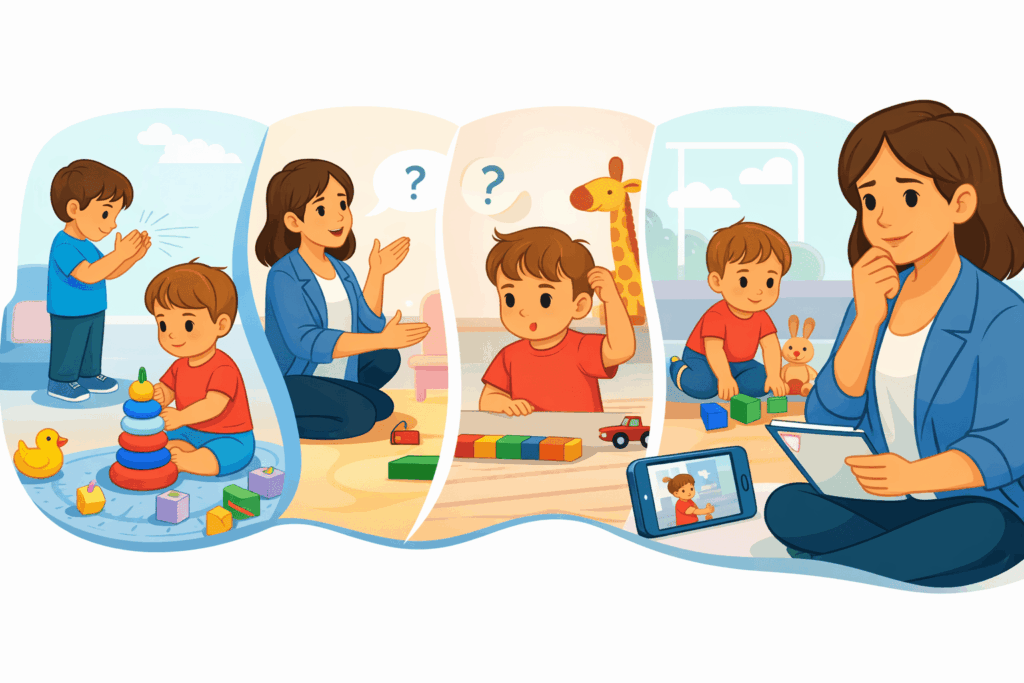
Noticing early signs of autism can bring up a swirl of emotions—worry, uncertainty, and a deep desire to “do the right thing” for your child. If you’re here because something feels different, you’re not overreacting. Many parents first spot small patterns that don’t quite fit the typical developmental path, and they start searching for answers.
This guide is meant to be calm, clear, and practical. You’ll learn common early signs of autism, how those signs can look at different ages, what to do next, and simple tips you can use at home. It’s not meant to diagnose your child—only a qualified professional can do that. But it can help you feel more confident in what you’re noticing and what steps to take.
What Are The Early Signs Of Autism?
Early signs of autism usually show up as differences in social communication, play and learning, and patterns of behavior or sensory processing. Some children show signs in the first year of life, while others become more noticeable later—especially when social expectations increase in toddlerhood or preschool.
It’s also important to focus on patterns rather than one-off moments. Every child has days where they’re tired, shy, or “in their own world.” What tends to stand out with autism is consistency over time, across settings, and across different interactions.
The Three Areas Parents Often Notice First
Many families begin noticing signs in these areas:
Social connection and communication can look like fewer back-and-forth interactions, less sharing of attention, or challenges using gestures.
Play and learning differences can show up as limited imitation, reduced pretend play, or playing in a repetitive way.
Repetitive behaviors and sensory differences can include strong routines, repetitive movements, intense interests, or heightened sensitivity to sounds, textures, or transitions.
Early Signs Of Autism By Age
Development doesn’t follow a perfect timeline. Still, there are common “red flags” by age that parents often bring up during screenings. The key is not to panic—but to pay attention when multiple signs cluster together or when skills aren’t emerging as expected.
Around 6 Months
At this stage, parents may notice reduced social smiling or fewer joyful expressions during interaction. Some babies don’t turn toward voices as often or seem less interested in faces.
This doesn’t automatically mean autism, but it can be a reason to watch social engagement more closely.
Around 9 Months
Many babies naturally start sharing expressions, sounds, and attention with caregivers. A possible sign is limited back-and-forth interaction, such as fewer smiles in response to your smile or less “social babbling” toward people.
Some parents also notice inconsistent response to their name, especially when the baby is not deeply focused on a toy or object.
Around 12 Months
By around 12 months, many children use gestures to communicate—waving, reaching, showing objects, and pointing (or starting to point). Possible early signs include limited gestures, limited interest in interactive games like peek-a-boo, and not consistently responding to name.
Another common difference is not showing or bringing items to caregivers to share interest, even if they can physically reach or grab what they want.
Around 16 Months
Speech and communication can vary widely, but by this stage many children have meaningful single words or are clearly communicating through gestures and sounds. A red flag can be few or no meaningful words, especially if communication relies mostly on crying, pulling an adult, or placing someone’s hand on an object rather than pointing or gesturing.
Some children may repeat sounds or phrases but use them in a way that doesn’t match the situation (for example, repeating a line from a video rather than using a functional word like “help”).
Around 18 Months
This is a big developmental window. Many children begin to expand pretend play, imitation, and shared attention. Parents may notice limited pretend play, reduced imitation of simple actions, or fewer “look at that!” moments where a toddler points to share something interesting.
Some toddlers point only to request (“I want”) but rarely point to share (“I see”). That difference—called joint attention—is often an area professionals explore during autism screening.
Around 24 Months
By 24 months, many children use short phrases and show growing interest in peer play. Possible signs include limited two-word phrases (that are meaningful and not just repeated), difficulty with back-and-forth play, and challenges with flexibility during routine changes.
It’s also common for parents to notice more intense reactions to transitions, changes, or sensory input as daily life becomes more complex.
Regression At Any Age
One of the most important signs to take seriously is regression—any loss of language, gestures, or social engagement that a child previously had. If you notice a clear loss of skills, it’s worth seeking support promptly.
Early Signs Of Autism In Babies Vs. Toddlers
In babies, signs often show up through social engagement and communication—eye contact, shared smiles, response to name, and use of gestures. In toddlers, signs may become more obvious through play, language development, and the ability to tolerate changes and transitions.
A toddler may appear to “know the words,” but struggle with using language socially—like answering questions, sharing experiences, or engaging in back-and-forth conversation. Others may become highly upset when routines shift, become intensely focused on a narrow interest, or show repetitive behaviors more clearly than in infancy.
Sensory Signs That Often Get Missed
Sensory differences are common in autism and can shape daily routines in big ways. Some children are hypersensitive—sounds feel painfully loud, certain textures feel unbearable, or bright lights feel overwhelming. Other children are hyposensitive or sensory-seeking—constantly moving, crashing, chewing, spinning, or seeking deep pressure.
These differences can show up as picky eating, resistance to hair brushing or clothing tags, difficulty with noisy public places, or intense meltdowns after sensory-heavy days. Sometimes the child isn’t “misbehaving”—they’re overwhelmed and communicating distress the only way they can.
A helpful first step is tracking patterns. Notice what happens before a meltdown, what environments seem hardest, and what helps your child recover.
Autism Signs Vs. Typical Development
Many parents worry they’re reading too much into normal toddler quirks. The difference is usually consistency, intensity, and functional impact.
For example, a toddler who ignores their name occasionally may be focused or tired. But a toddler who rarely responds to name across settings, shows limited gestures, and doesn’t share attention may benefit from screening. Similarly, many toddlers love routines—but rigid routines paired with intense distress during small changes can be a meaningful sign to explore.
If you’re unsure, it’s okay to trust your instincts and ask for guidance. Screening doesn’t label your child—it helps clarify what support might help.
What To Do If You Notice Early Signs Of Autism
If you’re seeing several signs that concern you, action steps can be simple and straightforward. You don’t have to do everything at once. Start with the next right step.
Step 1: Talk To Your Pediatrician And Ask For Screening
Bring a short list of what you’ve noticed and when you first noticed it. If you have short videos showing behaviors you’re concerned about (like lack of response to name, repetitive play, or difficulty with transitions), those can be helpful.
You can ask directly for developmental screening and autism-specific screening. If your provider seems unsure or suggests “wait and see,” you can still request a referral for evaluation, especially if you feel concerns are growing.
Step 2: Request A Developmental Evaluation
Evaluations can take time to schedule, so starting early helps. Even if you’re not sure about autism, an evaluation can clarify communication, sensory needs, and learning supports.
If your child qualifies for early intervention services, you can often start support while diagnostic questions are still being explored.
Step 3: Support Your Child At Home While You Wait
While you’re waiting for appointments, you can begin using gentle strategies that support communication, regulation, and connection. These aren’t “fixes.” They’re ways to make daily life easier and help your child feel more understood.
Practical Autism Tips For Home
You don’t need a perfect plan. Small adjustments can make a meaningful difference, especially when they reduce stress and increase connection.
One approach that helps many families is “join, then guide.” Follow your child’s interest first, then add tiny learning moments. If they love cars, sit with them, roll a car back and forth, copy what they do, and add a simple turn-taking routine. This builds engagement without forcing interaction.
For communication, use short phrases, pauses, and choices. Instead of asking open-ended questions, offer two options: “Apple or crackers?” Then wait long enough for your child to respond in their way—gesture, sound, word, or looking. Reinforce any attempt to communicate.
Routines also help, especially when transitions are hard. Use simple “first/then” language and predictable steps: “First shoes, then outside.” If your child struggles with change, build predictability around the process even when the activity changes.
And if sensory needs are part of the picture, respect them. Noise-canceling headphones, comfortable clothing options, and movement breaks before difficult tasks can reduce overwhelm and make learning more possible.
Trusted Resources Parents Can Use Today
The most helpful resources are the ones that reduce panic and increase clarity. Look for tools that track developmental milestones, explain early signs in plain language, and guide you toward evaluation pathways.
Be cautious with online content that promises quick “cures,” blames parenting, or uses fear as motivation. Autism is a developmental difference, and support should feel respectful, evidence-informed, and focused on quality of life.
If you’re overwhelmed, choose one resource that helps you track milestones and one resource that helps you understand evaluation steps. That’s enough to start.
What Parents Ask On Reddit And Quora
A lot of parents ask the same questions in online communities, often late at night when worry feels loud. Here are a few themes that come up frequently, along with grounded ways to think about them.
“My child doesn’t respond to their name—does that mean autism?” Not necessarily, but it’s worth noticing patterns. Consider whether it happens across settings, whether your child responds to other sounds, and whether engagement changes when you’re face-to-face. If it’s consistent, screening is a good next step.
“My child makes eye contact sometimes—does that rule autism out?” No. Many autistic children make eye contact sometimes, especially with familiar people or during preferred activities. Autism is not defined by one trait; it’s about a pattern across social communication and behavior/sensory areas.
“What should I do while waiting for an evaluation?” Keep notes, track what helps, and focus on building communication and regulation supports at home. You can also ask about early services that don’t require a final diagnosis to begin.
Where Therapy Support Can Fit
Early support is not about changing who your child is. It’s about strengthening communication, coping, learning readiness, and daily living skills so life feels easier—for your child and your family.
Many families explore support like play-based skill-building, communication development, and strategies for transitions and emotional regulation. When challenging behaviors show up, it can be especially helpful to look at what the behavior is communicating and teach safer, more effective replacement skills.
Bright Steps ABA In Atlanta
At Bright Steps ABA, we support families across Metro Atlanta with compassionate, individualized care that focuses on real-life skills and meaningful progress. Our team provides ABA Therapy that helps children build communication, independence, and learning readiness through structured, child-centered sessions, and we also offer Social Skills Training to support connection, play, and confidence with peers and caregivers in everyday settings. We partner closely with parents so you feel supported, informed, and equipped with practical strategies you can use at home.
Common Myths About Early Signs Of Autism
Some myths can delay support. One is “They’re affectionate, so it can’t be autism.” Many autistic children are deeply affectionate. Another is “They smiled, so it can’t be autism.” Social smiles can be present while other social communication differences still exist.
Another myth is “Just wait, they’ll grow out of it.” Some skills do emerge with time, but waiting without support can increase stress if challenges intensify. Early support is about giving your child tools sooner—especially for communication and regulation.
FAQs
What are the earliest signs of autism in babies?
Early signs can include limited social smiling, reduced back-and-forth interaction, inconsistent response to name, and fewer gestures like showing or pointing.
What are early signs of autism in toddlers (18–24 months)?
Common signs include limited joint attention (pointing to share interest), reduced pretend play, difficulty with transitions, repetitive play patterns, sensory sensitivities, and delayed functional language.
When should I talk to a doctor about autism signs?
If you notice multiple signs that persist over time, affect daily routines, or include any regression (loss of skills), it’s a good time to request screening and evaluation.
Can a child be autistic and still make eye contact?
Yes. Eye contact can vary widely. Autism is identified through an overall pattern of social communication differences plus repetitive behaviors and/or sensory differences.
What can I do at home while waiting for an evaluation?
Focus on connection and communication: follow your child’s interests, use simple language and choices, support transitions with “first/then,” and respect sensory needs with small environmental changes.
How to treat early signs of autism?
The best approach is early support tailored to your child’s needs—often focusing on communication, regulation, daily living skills, and social connection through developmentally appropriate therapies.
What is the best treatment for autism in the world?
There isn’t one “best” treatment for every child. The most effective support is individualized, family-centered, and focused on meaningful goals that improve daily life and independence.