
Acquiring a new skill requires a lot of time, hard work, and patience. Those actions that seem to be minor and easy for others are really difficult for autistic children since such skills include many small steps.
In this case, task analysis ABA is a teaching approach that proves to be extremely helpful for learning such skills. The main idea of using this method is to break down a certain skill into a series of simple steps. Kids start learning one step after another; besides, they are encouraged to make progress toward their goals.
It is safe to say that task analysis has proven itself to be one of the most efficient methods for education within Applied Behavior Analysis. It enables the development of daily skills for the children and decreases their frustration while making them more independent. If you are a parent, a caregiver, a teacher, or an inexperienced ABA therapist, knowledge about the process of task analysis will be of great help to you in this matter.
Here you will learn what task analysis is, how ABA therapists utilize it, and why it works so effectively.
What Is Task Analysis in ABA?
Task analysis in ABA is the breakdown of a complex skill into teachable parts. The steps are taught in an orderly way so that the child can master them until the skill becomes habitual and incorporated into his or her normal activities.
Most daily activities are actually very complex, comprising many parts and elements. For instance, handwashing involves several actions: opening the faucet, wetting your hands, adding soap to both of your hands, rubbing the hands, rinsing, closing the faucet, and using the towel to dry the hands. Omission of any single step would make the activity meaningless.
Task analysis makes this possible since all the steps involved in an activity are taught separately before being combined into a whole chain.
In ABA, the entire process is referred to as a behavior chain since each behavior or step leads to the other. Children can then master the whole process as they master each step.
Though task analysis is used by professionals in the realms of education, occupational therapy, etc., ABA therapy uses task analysis along with research-proven instructional techniques like prompting, reinforcement, modeling, data collection, etc.
Why Is Task Analysis Important in ABA Therapy?
All children have different learning styles. While some children learn new procedures easily, others need further assistance to feel comfortable with them. Task analysis enables therapists to cater to children’s varying needs instead of assuming that all learners will progress at the same pace.
Task analysis breaks down skills into small chunks, enabling children to concentrate on one chunk at a time. Additionally, task analysis creates uniformity. All individuals related to the child, which includes BCBAs, RBTs, teachers, and parents, follow the same sequence of steps.
Increased independence is another major strength of task analysis. As therapists reduce prompts and assistance, children start doing more actions by themselves. Eventually, most children do everything by themselves and gain more confidence in daily life.
Possibly the greatest advantage of task analysis is that it provides therapists with an opportunity to evaluate progress properly. Rather than just checking if the child completed the task, they gather data on each action separately.
How Does Task Analysis Work?
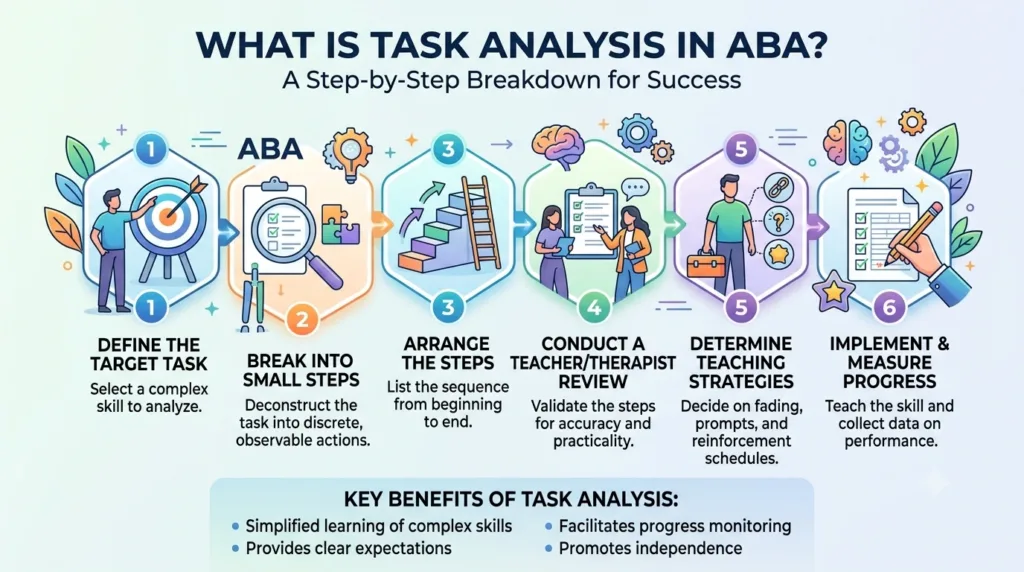
Task analysis follows a structured process, but it also remains flexible enough to meet each learner’s unique needs. ABA therapists carefully plan every stage before introducing a new skill.
The process begins by identifying a meaningful target skill. The therapist selects goals aimed at making the patient independent and improving their quality of life.
Before the teaching process begins, there is an assessment carried out by the therapist assesses whether the child possesses the prerequisite skills required for the process.
As soon as the child is prepared to begin the process, the therapist analyzes the task and divides it into parts that can easily be replicated by anyone teaching the child. Consistency prevents ambiguity and ensures progress in teaching.
The therapist next determines the most effective way to teach the child. Some children respond well to verbal teaching, while others respond better to demonstration, modeling, or guidance. Prompt fading is done as the child gains confidence.
Positive reinforcement continues to play a major role in the whole process. The child receives rewards after successfully completing certain steps.
Assessing Task Analysis Performance
Before teaching a new skill, ABA professionals need to understand what the learner can already do independently. This initial assessment helps determine where instruction should begin and which teaching strategy is most appropriate.
One commonly used method is the single-opportunity assessment. In this type of assessment, the child does the task on their own until they make an error or no longer respond. At this point, the therapist stops the assessment.
Another assessment type is the multiple-opportunity assessment. This assessment is different from the first one in that even if the child misses some initial steps, the therapist still continues with the process and helps the child perform all the steps.
Both types of assessment assist therapists in creating customized teaching programs based on real facts rather than assumptions.
Three Chaining Methods Used in Task Analysis ABA
After an ABA therapist conducts a task analysis, the next important step is to determine how to teach the sequence. This is where chaining becomes relevant. “Chaining” is defined as the procedure of teaching the sequence so that the learner masters all the steps of the process on their own.
There are different methods that depend on the learner’s individual characteristics.
Forward Chaining
Forward chaining is where the learner is taught the skill starting from the very beginning of the chain. The individual learns how to do the initial step by themselves before being taught the second step. Once both steps have been mastered, the third step is taught, and so on.
This type of learning is effective for individuals who learn best by following the normal sequence of events.
Backward Chaining
Backward chaining begins from the end of the sequence. The therapist does most of the work, while the client executes the last part by himself. With every success, the responsibility for carrying out the task moves backward along the sequence.
The reason why many therapists prefer backward chaining is that from the very beginning of therapy, the client experiences the satisfaction of accomplishing the task.
Total Task Teaching
The total task approach allows the child to go through all the steps of the process each time the therapy is conducted. The therapist does not concentrate on just one step in the process but rather helps only where required in order to enable the child to do as much as possible on his own.
This kind of approach is particularly useful for children who have prior experience with the task at hand and require help with some aspects of it.
Task Analysis ABA Example
Handwashing is one of the most common examples used in ABA therapy because it is an important daily living skill.
Rather than asking a child to “wash your hands,” an ABA therapist teaches every action involved in the routine. The child first learns to turn on the faucet, then wet both hands, apply soap, rub their hands together thoroughly, rinse away the soap, turn off the water, and finally dry their hands with a towel.
Everyday Examples of Task Analysis
Although handwashing and tooth brushing are common examples, task analysis supports many different areas of a child’s daily life. ABA therapists use this strategy whenever a skill involves multiple steps.
Brushing teeth remains one of the best-known examples. A therapist may teach the routine in the following order:
- Pick up the toothbrush and toothpaste.
- Remove the toothpaste cap.
- Apply toothpaste to the toothbrush.
- Brush all areas of the teeth.
- Spit into the sink.
- Rinse the mouth.
- Rinse the toothbrush.
- Put everything away.
The adaptability of task analysis is the reason why it is so useful in all sorts of home, educational, community, and therapeutic settings.
When do Therapists Use Task Analysis in ABA?
Task analysis is used in virtually every ABA program as independence is learned in daily experience.
Self-care routines such as dressing, washing, grooming, eating, and going to the bathroom are commonly taught through task analysis in ABA programs. These skills help kids feel more confident during their everyday routines.
Skills such as communication and socialization can also be acquired using this approach, since kids can practice the steps needed for certain social interactions.
As children grow older, task analysis can also support vocational readiness. Task analysis succeeds because it provides a consistent teaching approach across different environments.
BCBAs design the teaching plan, and Registered Behavior Technicians (RBTs) implement the program during therapy sessions.
How Parents Can Support Task Analysis at Home?
The parents’ role is critical in ensuring that children continue practicing their new skills beyond therapy hours.
Following the same procedure taught by the therapist builds a pattern that makes it easier for the child to know what to do next.
Celebrating small successes instead of demanding perfection is a crucial step that parents must take. Every completed step represents meaningful progress.
Common Mistakes to Avoid
Task analysis in ABA is most useful when all the participants maintain the same learning method.
Omission of certain stages could cause perplexity on the part of the child and dissatisfaction. It is wrong to teach too many skills simultaneously because children require time to get used to the routine.
Giving hints too quickly could deprive children of an opportunity to do something by themselves. Instead, therapists should lessen assistance and promote problem-solving where it makes sense.
Families also need to keep in mind that every child develops differently. It is not a good idea to compare progress to other children since this will not give an accurate reflection of the process.
Helping Children Build Independence with BrightSteps ABA
BrightSteps ABA runs individualized treatment programs, kinda tuned for every child depending on their strengths their goals and the way they learn, so it’s not really a one size fits all setup. Instead of the same approach for everyone, the center tweaks its strategies so independent skills can actually take hold, and grow.
Are you searching for ABA therapists in Atlanta? Stop scrolling and look no further than BrightSteps ABA. They offer personalized services in a caring, supportive manner, and they keep things focused on what matters most for each child.
FAQ’s
What is the difference between task analysis and chaining?
Task analysis involves breaking a complex skill into smaller steps. Chaining refers to the teaching method used to help a learner master those steps. In simple terms, task analysis creates the roadmap, while chaining guides the learning process.
Can parents use task analysis ABA at home?
Yes. Many ABA therapists encourage parents to practice the same step-by-step routines outside therapy sessions. Consistency between home and therapy helps children apply their skills in different environments.
How long does it take for task analysis to work?
There is no fixed timeline. Progress depends on the child’s current abilities, the complexity of the skill, and how consistently the routine is practiced. Some skills develop within a few sessions, while others require ongoing practice over several weeks or months.
What skills can therapists teach using task analysis?
Task analysis works well for daily living skills, communication, social interactions, academic routines, play skills, community participation, and vocational activities. Any activity that includes multiple steps can usually be taught through this approach.
Is task analysis only used for children with autism?
No. Although task analysis is widely used in ABA therapy for children with autism, professionals also use it to teach individuals with other developmental disabilities, cognitive challenges, and learning differences who benefit from structured instruction.
Conclusion
When a child is trying to learn all the skills involved in a particular activity at one time, it may become a daunting task. Task analysis ABA provides an answer to this challenge by dividing large activities into small ones. As every child is unique in their learning process, ABA therapists develop a task analysis program based on each child’s needs. This is how children acquire essential skills in their everyday life.