
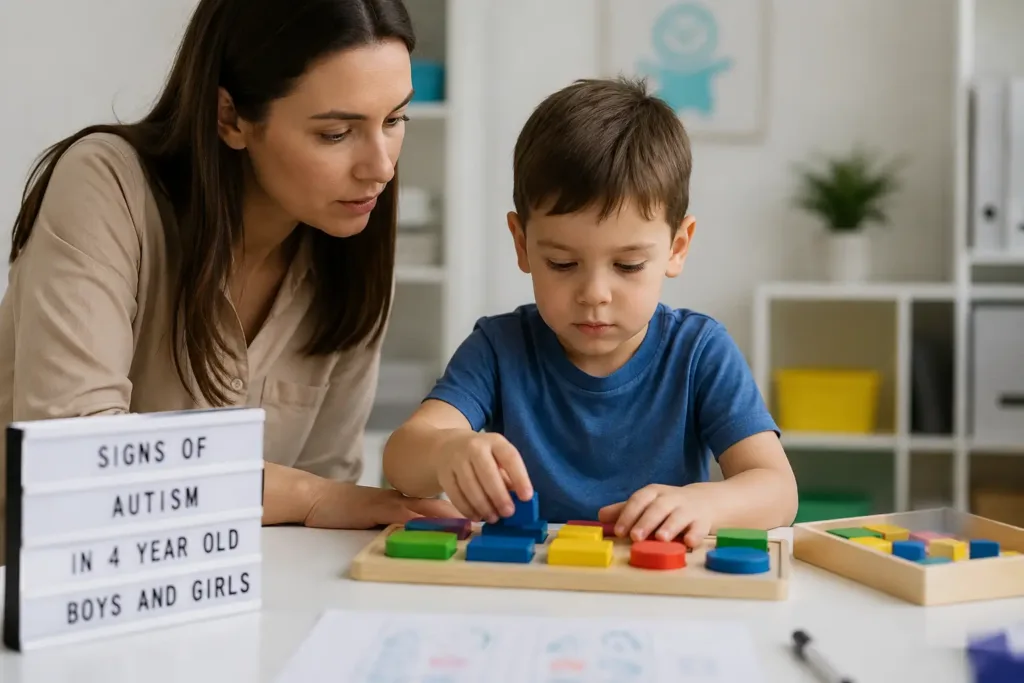
All children grow and develop at their own pace, but certain behaviors may cause parents to wonder whether their child is meeting developmental milestones. When looking for signs of autism in 4-year-old boys, it is important to remember that every child is unique. By age 4, most children become more social, talkative, and independent; however, some may experience challenges with communication, social interaction, or behavior. In some cases, these differences may be associated with autism spectrum disorder (ASD).
Autism impacts how a child communicates, relates to others, and reacts to their surroundings. Signs can differ from one child to another, and some may be more prominent in boys or girls.
Common Signs of Autism in 4-Year-Old Kids
Having an understanding of the regular indicators of autism in 4-year-old boys and girls can assist the parent in seeking help earlier if necessary. Here are some examples.
1. Difficulty with Social Interaction
Difficulty socializing is one of the most common symptoms of autism. Children’s play and communication skills develop nicely at 4 years, and they enjoy playing with other children, sharing, and talking. These social interactions may be more challenging for a child with autism.
Some possible signs will be:
- Playing alone
- Avoiding eye contact
- Unable to follow directions or perform well on routine tasks
- Trouble in expressing feelings or emotions
- Limited desire to make friends
Some children might want to engage but may not be sure how to fit in comfortably when interacting with others or participating in group activities.
2. Delayed or Different Communication Skills
Other common symptoms of autism are communication difficulties. Some of these 4-year-old autistic children may have delayed speech, others may be able to speak but not respond to a conversation.
Parents may observe that their children:
- Repeating words or phrases
- Speaking with an abnormal rate of speech or rhythm
- Having problems understanding simple questions
- Needs are not clearly expressed.
- Not using gestures such as pointing or waving to show what they want
Sometimes children have a different interpretation of language or may not be able to follow the rules of social communication.
3. Repetitive Behaviors and Strong Routines
A lot of children with autism have repetitive behaviors or have a strong need to stick to the routine.
Examples may include:
- Hand flapping
- Rocking back and forth
- Spinning objects repeatedly
- Lining up toys in a certain order
When routines are disrupted, children get upset, angry, or frustrated.
For example, a kid may need to go to bed the same way each night; otherwise, they assume they won’t fall asleep until the routine repeats.
4. Sensory Sensitivities
Kids with autism can be a little affected by sounds, lights, textures, or smells. But not all individuals will be affected by loud noises or large crowds.
These include:
- Blocking ears when exposed to loud noises
- Not wearing certain types of clothes
- Dislike of certain foods due to the texture of the food
- Watching spinning objects closely
- Strong reactions towards bright lights or strong smells
Sensory sensitivities may affect functioning in everyday life, at school, and in social settings.
Differences Between Boys and Girls
Boys and girls with autism show different signs and symptoms. Boys may be more aggressive in their repetitive behavior or communication problems. Sometimes girls are unable to recognize that they are having difficulties and mimic others’ behaviors, making autism more difficult to detect.
Some autistic girls might:
- Become quieter or shyer
- Have an intense interest in certain subjects
- Have difficulty making friends, but hide it well
- Easily become upset emotionally
Some girls may have signs that go undetected in the early stages.
Emotional and Behavioral Challenges
There are times when some children with autism are unable to regulate their emotions.
This can lead to:
- Frequent meltdowns
- Difficulty handling frustration
- Anxiety
- Difficulty in calming down
These types of reactions are not caused by intentional misbehavior. These reactions can result from communication issues or sensory overstimulation.
When Parents Should Seek Support
Any symptoms do not necessarily mean that a child is autistic; sometimes, a child may simply be at risk for autism. However, if several behaviors continue over time or interfere with daily functioning, it may be helpful to speak with a pediatrician or developmental specialist. Children can benefit from early support to improve their communication, social, and functional skills through services such as ABA therapy in Atlanta.
Conclusion
Some typical signs of autism in 4-year-olds, boys and girls are normally the same. It can be a lack of communication, social issues, repetitive behaviors, hyper-sensitivities to sensory stimuli, and anxiety. All children with autism have their own unique challenges and symptoms, which are often noticeable.
Early identification enables families to get guidance and support to help children develop key life skills. Many autistic children learn, grow, and develop in their own ways with understanding, patience, and the proper support.