

Daily routines can feel overwhelming when a child does not know what is coming next. For many autistic children, even small changes between activities can lead to stress, frustration, or difficulty transitioning. That is where visual schedules can make a real difference.
Visual schedules for autism give children a clear, simple way to see what will happen throughout the day. Instead of relying only on spoken directions, they use pictures, symbols, words, or objects to show each step in a routine. This helps create more predictability, reduce anxiety, and support greater independence over time.
What Is a Visual Schedule?
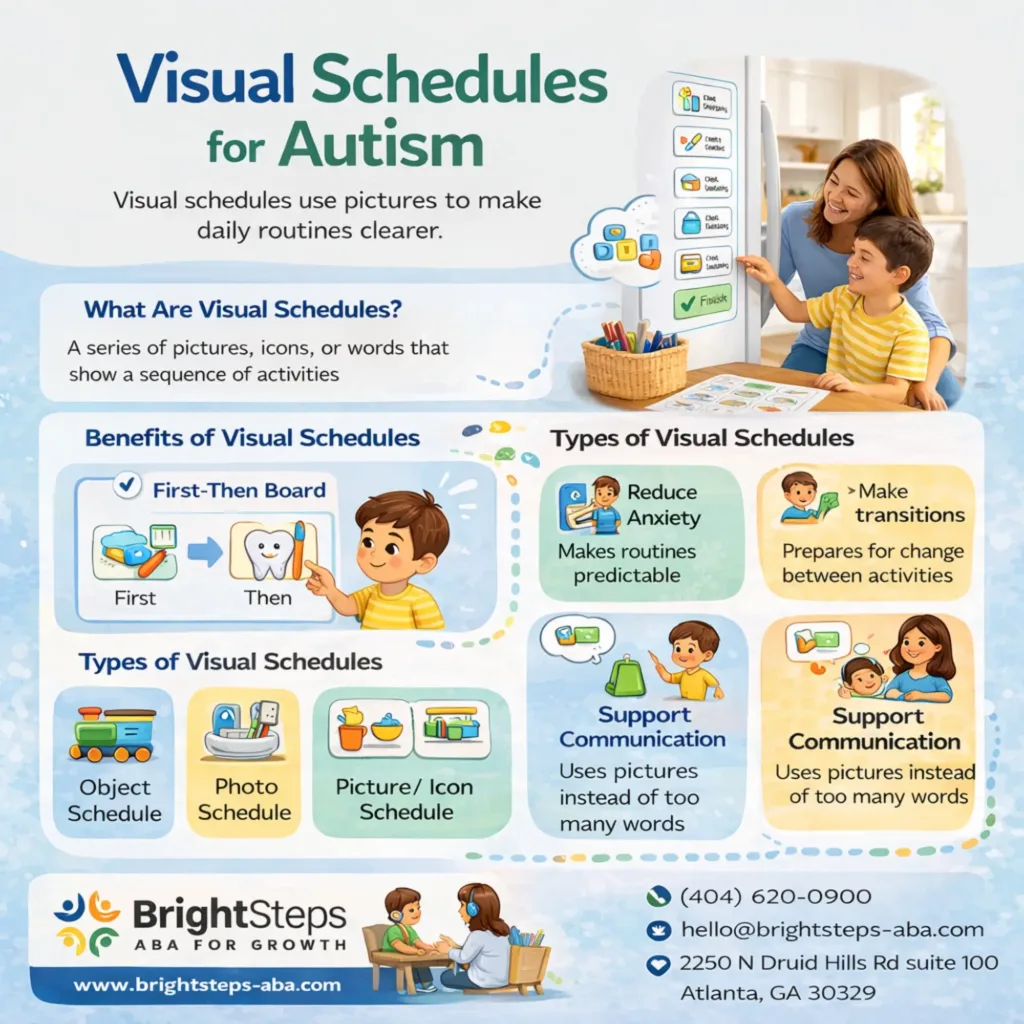
A visual schedule is a tool that shows a sequence of activities in a way a child can see and follow. It may include photos, icons, drawings, written words, or even physical objects, depending on the child’s age and communication style.
Some visual schedules show an entire day, while others focus on one small routine, such as getting dressed, brushing teeth, or completing homework. In many cases, simple schedules work best at first. A child may start with just two steps before moving on to a longer routine.
Why Visual Schedules Help
Many autistic children process visual information more easily than long verbal instructions. When a routine is shown clearly, it can reduce the pressure of having to remember each step or respond quickly to spoken directions.
Visual schedules also make daily life feel more predictable. Instead of wondering what will happen next, a child can look at the schedule and understand the order of activities. That predictability often helps reduce stress during transitions and can make routines feel calmer for both the child and the family.
Making Transitions Easier
Transitions are often one of the hardest parts of the day. Moving from playtime to lunch, leaving the house, or stopping a favorite activity can feel abrupt and upsetting. A visual schedule helps by showing what is ending and what is coming next.
When children can see the next step, they are often better prepared for the change. This does not mean every transition becomes easy right away, but it can lower uncertainty and create a smoother path from one activity to another.
Supporting Independence Step by Step
Visual schedules do more than organize a routine. They help children take part in that routine with more confidence. Over time, many children begin to rely less on constant reminders because the schedule itself becomes a guide.
That can be especially helpful with repeated daily tasks such as morning routines, bedtime, packing a school bag, or getting ready for therapy sessions. Even small gains in independence can build confidence and reduce stress for everyone involved.
Different Types of Visual Schedules
Not every child benefits from the same kind of schedule. The best format depends on how the child understands information, what setting the schedule will be used in, and how long the routine is.
Object Schedules
Object schedules use real items to represent activities. For example, a spoon may stand for snack time, or a shoe may mean it is time to go outside. This format can be useful for children who benefit from very concrete, hands-on cues.
Photo Schedules
Photo schedules use real pictures of familiar people, places, or activities. These can be especially helpful when a child responds well to images from their own daily life.
Picture or Icon Schedules
Picture schedules use drawings, symbols, or visual icons. These are common in homes, schools, and therapy settings because they are easy to organize and reuse.
Written Schedules
Written schedules work best for children, teens, or adults who read well and prefer text-based reminders. These may look more like a checklist than a picture chart.
First-Then Boards
A first-then board is a simple version of a visual schedule. It shows one expected activity followed by one preferred activity. For example, “First shoes, then outside.” This is often a great starting point for children who are still learning how schedules work.
Digital Schedules
Some families use tablets or phones for digital visual schedules. These can be convenient and portable, especially for older children. Still, digital tools are not always the best choice for every child, especially if the device itself becomes distracting.
How To Choose the Right Visual Schedule
The right schedule should match the child, not the other way around. A schedule that works well for one child may not be the best fit for another.
Start by thinking about how your child understands information. Do they respond best to real objects, photos, simple symbols, or written words? Consider attention span as well. Some children do better with a full-day schedule, while others need only a short routine with two or three steps.
It is also important to think about where the schedule will be used. A large wall schedule may work well at home or in a classroom, but a portable version may be more helpful when going to therapy, visiting a store, or traveling.
How To Create a Visual Schedule
Creating a visual schedule does not have to be complicated. The goal is to make the routine easier to understand, not to create something perfect.
Start With One Routine
Choose one part of the day that often feels stressful or confusing. Morning routines, bedtime, after-school routines, and getting ready to leave the house are common places to start.
Break the Routine Into Small Steps
Keep each part of the routine simple and specific. Instead of one broad step like “get ready,” break it into smaller actions such as brush teeth, get dressed, put on shoes, and grab backpack.
Choose Clear Visuals
Use visuals your child can easily understand. That may be a real photo, a simple icon, or a written phrase. The most important thing is that the meaning is clear to your child.
Put the Steps in Order
Arrange the visuals in the sequence the routine happens. This can go top to bottom or left to right, depending on what feels easiest to follow.
Add a Way To Show Completion
Many children benefit from seeing when a step is finished. You might move the card to a finished section, flip it over, or check it off. This gives a clear sense of progress.
Teach It Slowly
Do not expect instant independence. At first, you will likely need to guide your child through the schedule and point to each step. Over time, many children begin to use it more independently.
Using Visual Schedules at Home
Home is one of the most practical places to use visual schedules because routines happen there every day. They can support both children and parents by reducing repeated reminders and helping the day feel more organized.
Morning Routines
A visual schedule can help children move through tasks such as waking up, using the bathroom, getting dressed, eating breakfast, and leaving for school. Morning stress often comes from rushing and repeated prompts, so having a visual guide can make this time feel more manageable.
After-School Routines
The time after school can be difficult because children may be tired, hungry, or overstimulated. A schedule can show what happens after arriving home, such as snack, quiet time, homework, play, or dinner.
Bedtime Routines
Bedtime schedules can be especially useful because they create a predictable sequence that leads toward sleep. Bath, pajamas, brushing teeth, story time, and lights out may all feel easier when shown step by step.
Using Visual Schedules in School and Therapy
Visual schedules are also valuable in classrooms and therapy settings because they help children understand expectations, reduce uncertainty, and stay engaged.
A teacher may use a whole-class visual schedule to show the order of the school day. A therapist might use a mini schedule for a session, showing activities such as greeting, table work, movement break, and reward. Some children benefit from having their own portable schedule at a desk or on a clipboard.
When the same general approach is used across settings, it can help children feel more secure and make routines easier to follow.
What To Do When Plans Change
One concern parents often have is what happens when the day does not go as planned. A visual schedule is helpful because it provides structure, but life is not always predictable.
That is why flexibility matters. When a change happens, it can help to update the schedule visually rather than only saying the change out loud. You might remove a card, replace it with a new one, or use a simple symbol to show that plans changed.
This can help children see that while the routine is different, there is still a clear path forward. The goal is not to make the day perfectly rigid. The goal is to make it easier for the child to understand what is happening.
Common Mistakes To Avoid
Visual schedules are most helpful when they are simple, clear, and meaningful to the child. Sometimes they do not work well because they are too long, too cluttered, or too advanced for the child’s current understanding.
Another common mistake is introducing the schedule but not teaching it. A child may need repetition, modeling, and support before the schedule becomes useful. It is also important to update the schedule when routines change so it stays relevant and trusted.
Do Visual Schedules Help Older Children and Adults?
Yes, visual schedules are not just for young children. Older children, teens, and adults can still benefit from seeing routines clearly laid out. The format may simply look different.
For an older child, a visual schedule might be a written checklist for homework, hygiene, school preparation, or chores. For teens and adults, it might be a phone reminder system, a planner, or a step-by-step routine for work and community tasks. The need for predictability and clear expectations does not disappear with age.
When To Seek Extra Support
Sometimes families try visual schedules and are not sure whether they are using them in the best way. In those cases, extra guidance can be helpful.
If your child is struggling with transitions, becoming upset during routines, or not responding to the visuals you are using, it may help to talk with a professional who understands autism and behavior support. A well-designed schedule should fit the child’s needs and be adjusted over time as skills grow.
How Brightstep ABA Can Help
At Brightstep ABA, we work with families to build practical routines that support everyday life, not just therapy goals. That can include helping children use visual schedules for morning routines, transitions, self-care tasks, school readiness, and other daily challenges. Our approach is family-centered, personalized, and focused on making skills feel meaningful in real life.
Final Thoughts
Visual schedules for autism can be simple, but their impact can be powerful. They help turn uncertainty into clarity and make routines easier to understand one step at a time.
Whether you are starting with a first-then board or building a full daily routine, the best visual schedule is one that fits your child’s needs and can be used consistently. With patience, support, and the right structure, visual schedules can help children feel more secure, more prepared, and more independent in everyday life.