Children’s behaviors, whether joyful, challenging, or puzzling, are never random. Every action has a purpose, especially for children with autism and developmental challenges. Understanding why your child engages in certain behaviors is the first step to helping them grow. That’s where the Four Functions of Behavior come in.
In the world of Applied Behavior Analysis (ABA), these four functions help parents and therapists get to the root of behavior so we can respond with empathy, guidance, and effective support.
1. Attention-Seeking Behavior
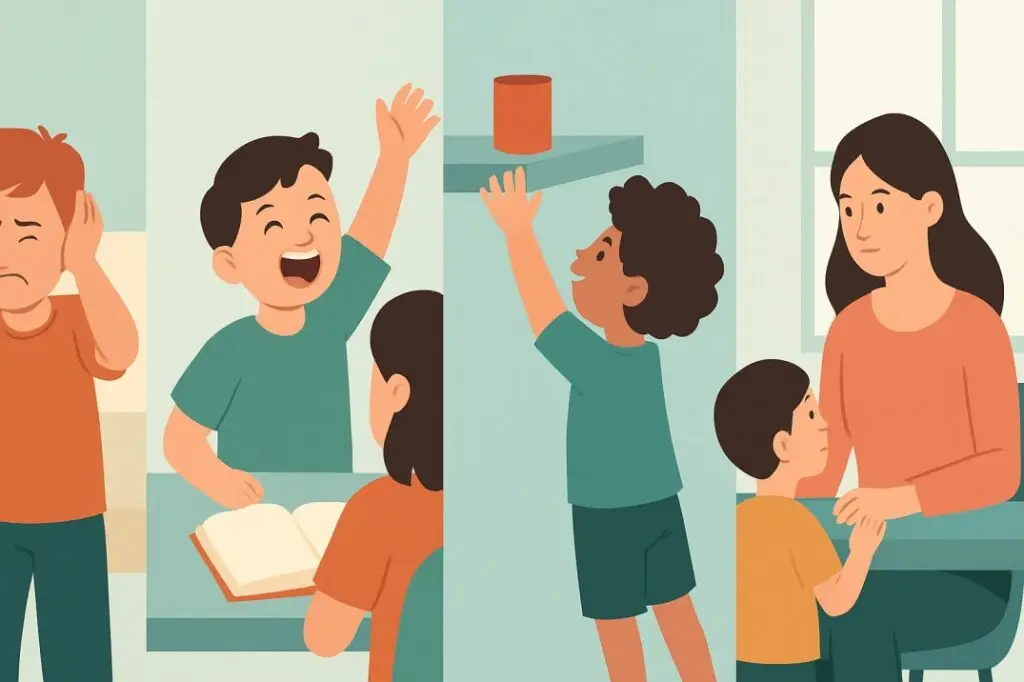
Your child might be trying to connect even if it doesn’t seem that way at first. We all crave connection. When children don’t yet have the tools to ask for help, affection, or acknowledgment, they might act out to get attention. This can look like yelling, hitting, or repeating behaviors they know will get a response positive or negative.
For example, if your child throws toys every time you’re on a phone call, it might be their way of saying, “Look at me. I need you.” Understanding this helps shift the focus from punishing the behavior to teaching more appropriate ways to ask for attention.
2. Escape or Avoidance Behavior
Sometimes, your child might just want a break.
Avoiding difficult tasks, environments, or even people is a natural response especially when something feels overwhelming. In children with autism, escape behaviors may show up during transitions, new routines, or unfamiliar learning tasks. Your child may cry, run away, or shut down completely.
They’re not being “difficult” they’re communicating that something is too hard, too fast, or too stressful. ABA strategies can help identify what triggers the behavior and how to gradually build tolerance in a safe, supportive way.
3. Access to Tangibles
Your child might be trying to get something they want but doesn’t yet know how to ask.
This function is about obtaining a desired object or activity. Maybe your child hits a sibling to get the tablet, or has a meltdown in the grocery store when they want a snack. These behaviors aren’t about disobedience they’re about communication gaps.
ABA therapy helps children learn functional communication whether it’s through speech, signs, or visual supports so they can express their wants and needs more calmly and clearly.
4. Sensory Stimulation (Automatic Reinforcement)
Some behaviors simply feel good or help your child feel safe.
This is one of the trickiest functions to recognize. If your child engages in behaviors like hand-flapping, spinning, rocking, or humming, it may be meeting a sensory need. These actions often continue even without others around, because they’re internally rewarding.
Rather than trying to stop these behaviors outright, ABA therapists work with families to understand whether the behavior is harmful or helpful, and how to redirect it when necessary.
Understanding the ABCs of Behavior
To uncover the function of a behavior, therapists often use the ABC model:
- Antecedent – What happens before the behavior?
- Behavior – What does the child do?
- Consequence – What happens after the behavior?
Using this framework helps uncover patterns and creates opportunities for positive behavior support.
This process is part of what we refer to as School-Based ABA Support, where children receive guidance in real-world settings like classrooms, helping bridge the gap between therapy and everyday life.
School-Based ABA Support vs. Clinic-Based ABA Therapy
Both environments have their strengths, and often a combination works best.
- School-Based ABA Support helps children generalize their skills in everyday settings, surrounded by peers and structured routines.
- Clinic-Based ABA Therapy offers a focused environment where therapists can address behaviors in-depth with fewer distractions and tailored tools.
At BrightSteps, we offer both options in Atlanta, giving your child a flexible path to growth—whether they need extra help at school or benefit from focused sessions in our supportive clinic space.
How BrightSteps Empowers Children Through ABA Therapy in Atlanta?
BrightSteps partners with families in Atlanta to support children with autism and developmental delays. Through ABA therapy, we work to:
- Build communication and daily living skills
- Foster emotional regulation and independence
- Create meaningful progress in a nurturing, play-based environment
Our team is passionate about helping children reach their full potential one small step at a time.
Whether it’s in schools, homes, or our clinic, your child receives individualized care that meets them where they are and supports where they want to go.
FAQs About the Four Functions of Behavior
How do I figure out which function is driving my child’s behavior?
A behavior analyst uses observation, data collection, and the ABC model to determine the most likely function. It’s not always obvious but the patterns become clear over time.
Can a behavior have more than one function?
Yes! Sometimes a behavior serves multiple functions. For example, a tantrum might be both a way to escape a task and get attention. ABA helps uncover these layers.
Are sensory behaviors bad or wrong?
Not at all. Many sensory behaviors (like hand-flapping or rocking) help children self-regulate. ABA therapy focuses on understanding these behaviors not eliminating them unless they cause harm.
What if the behavior keeps happening even after interventions?
Behavior change takes time. If something isn’t working, therapists reassess and adjust the strategy. Flexibility and consistency are key.
Final Thoughts: A Better Understanding Builds Better Support
When parents understand why a behavior is happening, they’re better equipped to respond with patience, compassion, and strategy instead of frustration. The Four Functions of Behavior aren’t just a clinical tool they’re a way to build connection, trust, and positive growth with your child.