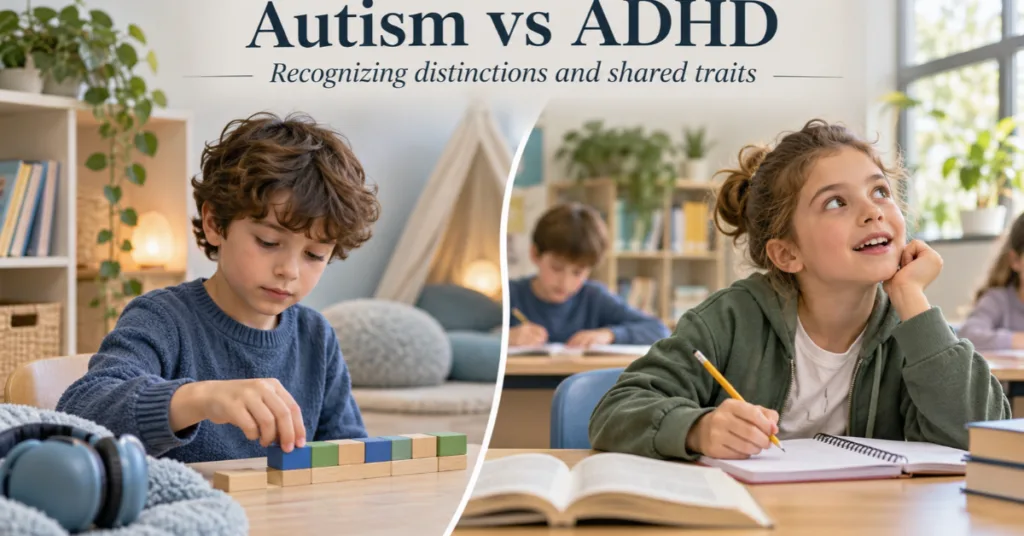
There are two distinct forms of neurodevelopmental disorder – autism and Attention Deficit Hyperactivity Disorder (ADHD). They can have some of the same features – difficulties with socializing for instance, sensory issues, difficulties with emotional regulation. They both impact the way in which a child communicates, learns, focuses and engages with the world – just in different ways.
Knowing the difference between ADHD and Autism can help parents to spot the warning signs and get the help they need. In this article we look at the main differences, the common features, the diagnosis and how behavioral therapy can be of benefit. Please note that the presence of a few of the symptoms is not in itself a diagnosis. A child’s needs must be assessed by a qualified professional.
What is Autism Spectrum Disorder (ASD)?
Autism Spectrum Disorder (ASD) affects communication, relationship, sensory and routine processing or interests. Every child with autism will have a range of abilities, strengths and the supports that they will require.
Common Signs of Autism in Children
Here are some common signs of Autism in children:
- Having the complete inability to make heads or tails of what people are saying to each other.
- Having difficulty with back and forth conversations or social cues.
- Likes and dislikes of the routine, upset by change.
- High levels of interest in particular areas of activity or interest.
- Repeating actions, words and movements.
- An atypical response to sound, light, texture or any other sensory input.
Not all autistic children will present in the same way. The patterns are indicative of an evaluation need, they don’t diagnose autism.
What is Attention Deficit/Hyperactivity Disorder (ADHD)?
ADHD is a neurological disorder characterized by inattention, hyperactivity and impulsiveness (all of which impair functioning). ADHD children often find school work, daily tasks, routine and relationships very difficult. Not all children with ADHD are hyperactive.
Defining the terms:
Inattention: a child may forget instructions, lose school things, fail to attend to detail or lose focus on a task (e.g. homework).
Hyperactivity: excessive movement, talkativeness and inability to sit still.
Impulsivity: a child may not be able to take turns in conversation, may interrupt or may answer before the question has even been finished.
These features can occur in all sorts of combinations and to varying degrees. With regard to autism and hyperactivity, it’s important to bear in mind that a child with autism may be quite hyperactive without that necessarily being a sign of ADHD.
Autism vs ADHD: What are the key differences?
The commonality is that they can both have an impact on the learning and social experience, but the nature of the conditions is quite different.
| Area | Autism | ADHD |
| Social interaction | May find it difficult to understand social cues or connect with others. | May struggle socially due to distractions or impulsive actions. |
| Focus | May concentrate deeply on particular interests. | May struggle to stay focused but become deeply engaged in enjoyable tasks. |
| Routines | Often feels more comfortable with familiar routines. | May have trouble organizing tasks and sticking to routines. |
| Repetitive behaviors | May repeat movements or actions for comfort, enjoyment or self-regulation. | Repetitive behaviors are not a main characteristic of ADHD. |
| Sensory needs | May be more or less sensitive to sounds, lights, textures or touch. | May also experience sensory sensitivities or seek sensory input. |
| Hyperactivity | May show increased movement related to sensory needs or self-regulation. | May be restless, talk excessively or struggle to sit still. |
| Communication | May find it challenging to express thoughts or interpret social communication. | May interrupt others, lose track of conversations or speak impulsively. |
| Emotional regulation | May feel overwhelmed by sudden changes or sensory experiences. | May have difficulty managing frustration, impulses or strong emotions. |
Note: These are general patterns that illustrate the differences and overlap between ADHD and autism. They should not be used as a diagnostic checklist, as children may exhibit characteristics of both conditions.
Social Communication and Friendships

An autistic child may have difficulty with facial expression or tone, or with working out the unspoken social rules. An ADHD child may be the one to read between the lines, but they may also interrupt, forget what they’re saying, or react instantly without thinking.
It can be a difficult time for the children in terms of making friends, just for different reasons.
Attention, Interests, and Executive Functioning
For some autistic kids it is possible to get absolutely fixated on a subject that they like but can’t seem to switch off from. Some kids with ADHD will have difficulty with the ability to sustain attention on a task, particularly on a repetitive or boring task. They can become very absorbed in a fun activity but again the issues with panning, organizing and completing a task can be present in both conditions and that is part of the executive functioning overlap between ADHD and autism.
Routines, Repetitive Behaviors, and Sensory Needs
Autistic kids may well enjoy having routines and may like to repeat movements and activities. It can be very difficult for them if things are suddenly different. Kids with ADHD can also have problems with forgetfulness and with organizing their own routines. Sensory sensitivities can occur in either condition so can’t be used as a sole indicator of either.
When you’re comparing ADHD overstimulation to autism overstimulation you have to bear in mind that children with either of those conditions can become overwhelmed by a noisy environment, a busy environment, or just an overload of sensory input. The experience and the support required will be different in each case.
What symptoms do autism and ADHD have in common?
Several ADHD and autism similarities can make it difficult for parents to distinguish between the two conditions. Emotional regulation issues, social difficulties, sensory differences and executive-function problems can be present with both conditions.
Common overlapping characteristics may include:
- Difficulty regulating emotions.
- Difficult to sustain attention on some of the activities.
- Sensitivity to environmental stimuli.
- Difficulties in developing or sustaining friendships.
- Problems with planning and organization.
- Difficulty transitioning between activities.
When evaluating autism symptoms vs. ADHD symptoms, it helps to step back and look at your child’s broader developmental patterns rather than zeroing in on isolated behaviors.
Why Similar Behaviors May Have Different Reasons
Suppose a child is leaving the classroom and there’s a fairly noisy activity on going. One child may just walk out because the noise is too much. Others may walk out because they simply can’t concentrate or sit still. The action is the same, the motivation and reason may be different.
If a professional has an understanding of what is going on prior to and at the time of the behavior they will have a much better idea of what the child’s needs are.
Can a child have both autism and ADHD?
Yes an individual can have both autism and ADHD. If both are present then the characteristics of both conditions can overlap and complicate a child’s needs.
It’s important to be aware of the presence of ADHD symptoms in children with autism, as the problems with attention, impulsivity and hyperactivity may well warrant further assessment and some form of specific support.
What Does AuDHD Mean?
Some people will refer to having both autism and ADHD as AuDHD (Autism plus ADHD). It’s not a diagnosis per se, but it’s important to recognize the difference between ADHD and AuDHD. A child who has both will obviously require support that takes into account the very different nature of the two conditions.
How are autism and ADHD diagnosed?
The diagnosis is a full-blown assessment. Developmental history, direct observation of the child, interviews with parents and/or teachers and the use of appropriate assessment tools are all part of the process. Absolutely no one internet quiz can diagnose either condition.
Overlapping features can at times lead to the misdiagnosis of ADHD or autism, especially if the assessment is based solely on the individual symptoms and doesn’t take into account the child’s full developmental history.
Who can evaluate a child?

An assessment can be carried out by a developmental pediatrician, a child psychologist, a child psychiatrist or indeed any other appropriate clinician as may be required for a particular child. The pathway through the assessment will of course vary depending on the location and the health care system.
How can behavioural therapy help children with autism or ADHD?
Behavioral support should be individualised to the individual child and to the individual goals.
Behavioral Support for Children With Autism
ABA therapy is about using individualised teaching to build up communication, social and daily living skills. The goals have to be meaningful to the child and must take into account what the child is comfortable with and what they like.
Behavioral Interventions for Children With ADHD
Attention, organization, routines and behavior management skills can all be worked on with children who have ADHD using Parent Training and Classroom Behavior Strategies. Medication may also be an element of a comprehensive treatment plan with a clinician.
How can parents support a child with autism, ADHD or both?
At Home and at School
Parents can of course help the child by giving them clear, straightforward instructions, by changing to a quieter or less distracting environment and by giving them a movement/sensory break when required. Working in partnership with the teacher is another way of ensuring that the support is consistent between home and school.
When to Seek an Evaluation in Atlanta
Parents in Atlanta, GA, who notice signs of autism or ADHD should consult their child’s pediatrician. Following an autism diagnosis, families can explore ABA therapy in Atlanta, GA for individualized developmental support.
Conclusion
Autism and ADHD are linked, can be very similar and a child can have both. Understanding the difference can help a parent to get the right assessment and the right individual support rather than just assume it or go on some online checklist.
Frequently Asked Questions
Is ADHD related to autism?
Yes, ADHD and autism are two distinct neurodevelopmental conditions which can have some of the same features (difficulties with attention, emotional regulation, sensory processing, social interactions etc). They are different conditions with different diagnostic criteria, although they can both be present in the same child.
Can autism be mistaken for ADHD?
Yes. There is some overlap in the characteristics (e.g. attention, social and emotional regulation). A full assessment will provide information as to the child’s needs and whether or not either one or both of the conditions are present.
Can signs change with age?
Yes. As a child grows and encounters new demands at home and school, how autism or ADHD manifests can also vary. There is also a possibility that a person’s support needs will change over time.
Can You Have Both ADHD and Autism?
Yes, a child can be diagnosed with both ADHD and autism. This co-occurrence is informally known as AuDHD. Children with both conditions may experience overlapping challenges with communication, attention, impulsivity and sensory regulation. A comprehensive professional evaluation can help identify their individual support needs.