
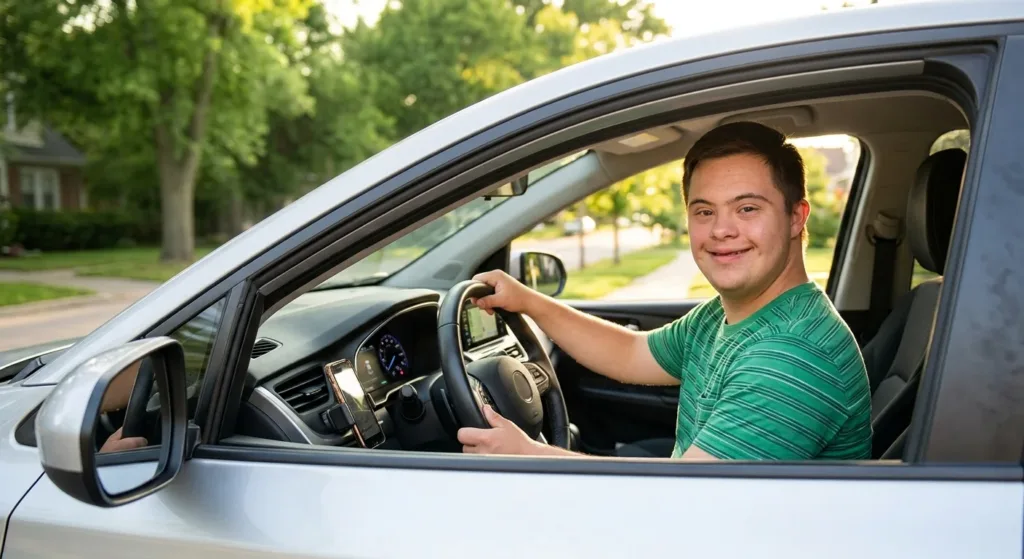
Yes, there are individuals with Down syndrome who can learn to drive safely, but it is a different situation for each person. Don’t assume that someone with Down syndrome cannot drive. The important question is whether the driver is physically, cognitively, visually, and emotionally competent to drive safely.
Driving is an important milestone towards independence. It can make it easier to get to work, school, appointments, social events, and other daily activities. But learning to drive should be based on the person’s abilities, not a diagnosis like Asperger Syndrome. With proper training, evaluation, and practice, some individuals can learn to drive safely and become confident drivers.
What Skills Are Needed for Driving?
You can’t just learn how to operate the pedals or the steering wheel to drive. Drivers must make decisions and act quickly and appropriately to meet the demands of changing situations.
There are some important skills, such as:
- Know and understand the meaning of traffic signs and signals.
- Following road rules
- Not paying attention to other cars/persons while driving
- To perform speed and distance judgment.
- This involves making choices at crossroads.
- Dealing with an emergency; coping with unexpected events
- Safely managing the vehicle, including traffic, parking and road access
- Skills to recall directions and procedures
These skills can be learned by someone with Down syndrome. Some may require more practice, or someone else may be able to learn to drive with the help of a proper instructor.
How Does Down Syndrome Affect Driving?
Down syndrome may involve differences in learning, communication, coordination, or information processing. These differences may not affect everyone enough to make them unsafe to drive, but you should consider them when evaluating driving safety.
For example, someone might know some traffic laws but take longer to decide when more than one thing is happening at once. This can happen with quick decisions, such as at busy intersections, in heavy traffic, or when you get onto unfamiliar roads or encounter unexpected hazards.
A person may also have physical and sensory needs, such as a visual or hearing disability. Address and manage these appropriately before driving.
The aim is not to assume people can’t drive. Rather, it should be based on their strengths and weaknesses and whether they need extra support in any of these areas.
Can People with Down Syndrome Learn to Drive?
Yes, some can. Some people may take a bit longer to learn to drive, and a bit more practice can help. With a qualified driving instructor, learning can be divided into steps using Task Analysis in ABA. Each step builds individual skills, making the process easier to follow.
For example, the first phase of training could take place in a still environment, focusing on vehicle controls. The learner can then practice steering, braking, turning, and following simple routes, then move on to more complex traffic situations.
Practicing helps make key driving actions more familiar.
Why Is a Professional Driving Assessment Helpful?
A professional evaluation can provide valuable information before deciding whether someone is ready to drive independently.
A trainer or driving rehabilitation specialist assesses the following areas:
- The ability to see and use their eyes, legs, and feet.
- Attention and concentration
- Reaction and coordination
- The capacity to recognize what is happening on the road.
- Decision-making skills
- Knows how to listen and comprehend directions
- Vehicle control
A driving instructor can then evaluate practical driving in real-life scenarios.
What About the Driving Test?
The person still must meet the licensing requirements in their area. They include written knowledge tests, vision and practical driving tests, and other requirements stipulated by local law.
It’s not the diagnosis of Down syndrome that’s the deciding factor for the awarding of a driving license. Licensing is typically based on the person’s compliance with safety and legal criteria.
How Families Can Support a New Driver?
Family support is essential to make the learning process easier, but it is important not to be involved entirely.
Families can support by offering practice and space for children to practice skills repeatedly, in a relaxed setting. They can also encourage the learner to discuss situations in which they face difficulties.
Valuable assistance can be provided by:
- Practicing familiar routes
- Reviewing road signs
- Presenting the instructions in a clear and simple manner
- Providing additional time for learning experiences
- Safely learning to ride in a variety of traffic scenes over time
- Encouraging safe decision-making
- Positive reinforcement and encouraging students, but not stressful
Finally, independence does not mean you have to do everything on your own. If you can drive but need help with another part of your trip, you may need that support.
What If Someone Is Not Ready to Drive?
Not being prepared to drive doesn’t mean a person can’t live an independent or active life.
Some people need further training before taking their driving test. Some people may conclude that driving isn’t a good option for them. Alternatively, public transportation, community transportation, family members, cycling, or other transportation options can help.
The first and foremost is the person’s safety; the issue is not whether they reach a certain level of independence.
Safety Should Always Come First
Freedom comes with responsibility when it comes to driving. Do not drive if you are unable to “control” the vehicle, to know what is happening on the road, or to cope safely with hazards.
If attention, vision, reaction time, judgment, or other skills are a concern, speak with the appropriate healthcare or driving professional to ensure you receive the necessary support.
Final Thoughts
Then, can individuals with Down syndrome operate a motor vehicle? Yes, some people with Down syndrome can be trained to drive and may be able to obtain a driving license. But Down syndrome isn’t the same for each person, and no one should have a single solution.
It is best to observe the person’s actual skills, provide the necessary training, and, if needed, consult ABA services Atlanta for a professional assessment. Some individuals with Down syndrome can learn to drive with realistic expectations, patient teaching, and an emphasis on road safety, and become more independent.