
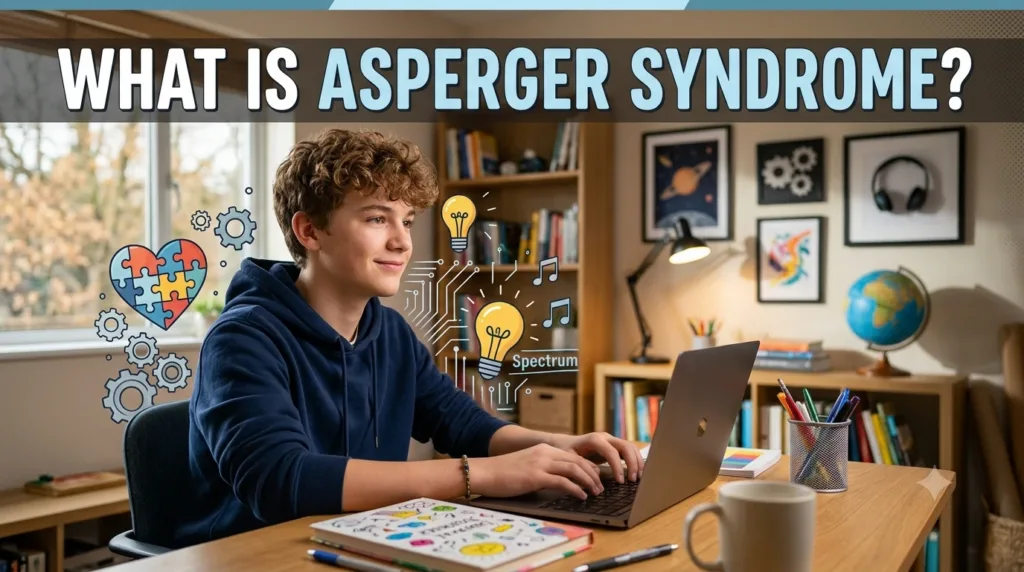
When your child struggles to make friends, misses social cues, or becomes intensely focused on certain interests, it’s natural to wonder whether these behaviors are part of typical development or something more.
Many parents searching for Asperger syndrome are simply looking for clear, trustworthy answers. Asperger syndrome was once a separate diagnosis but is now part of Autism Spectrum Disorder (ASD). This guide explains what it means today, its common signs, possible causes, how it’s diagnosed, available treatments, and when it may be time to seek an evaluation.
What Is Asperger Syndrome?
Asperger syndrome is a term used to describe a specific type of autism. People with this profile are usually very smart and have excellent language skills, but they find it hard to understand social rules, talk with peers, and read body language.
Many families and adults still use this name today. They use it because it perfectly describes a person who can speak well but struggles to make friends or understand unspoken social cues.
Doctors do not give this name as a new diagnosis anymore. In 2013, the official medical manuals changed. Doctors combined several different conditions into one larger group called Autism Spectrum Disorder, or ASD.
This change happened so that people could get the exact help they need based on their daily challenges rather than a label. Even so, many adults who were diagnosed years ago still prefer to say they have Asperger’s because it feels like a core part of who they are.
Asperger Syndrome vs. Autism Spectrum Disorder
The table below shows the differences between the old definition of Asperger’s and classic autism:
| Feature | Old Asperger Syndrome Criteria | Classic Autism Spectrum Disorder (ASD) |
| Learning to Talk | No delays. Children speak on time. | Often causes delays or speaking very few words. |
| Intelligence | Average or very high. | Varies from highly gifted to learning disabled. |
| Making Friends | Wants to have friends but does not know how. | May prefer to be alone and avoid others. |
| Focus | Deep interest in one or two specific topics. | Repetitive movements like rocking or hand-flapping. |
| Current Doctor Diagnosis | Now called Autism Spectrum Disorder (Level 1). | Active name used for all levels of autism. |
What Are the Symptoms of Asperger’s Syndrome?
People with Asperger’s syndrome often show a specific mix of high intelligence and social difficulties. While they usually speak very well, they experience the world and interact with others in a unique way. The following points show the most common signs you might notice in their daily life.
- They find it hard to read body language, facial expressions, and other unspoken social signals.
- They take language completely literally and often get confused by jokes, sarcasm, or common figures of speech.
- They struggle to manage the natural give and take of a normal two-way conversation.
- They become fascinated with certain hobbies and accumulate huge amounts of information on these subjects.
- They are used to their routine and become much stressed when their routine is changed suddenly.
- They become intensely overstimulated by things they see, hear and feel in their everyday surroundings such as loud sounds, bright lights or the texture of rough clothing.
- When their nervous system is overloaded, they may feel extremely exhausted emotionally, or have sudden meltdowns.
- They show signs of physical clumsiness, such as a stiff way of walking or trouble with fine hand tasks like writing and buttoning coats.
- They try to copy the actions of their peers to fit in socially, which leaves them feeling completely exhausted.
What Causes Asperger’s Syndrome?
While there is no single reason, research shows that it is a natural brain difference a child is born with. The following points explain the main factors that researchers look at today.
- Family DNA plays the biggest role because these specific brain traits tend to run in families.
- Multiple different genes passed down from parents combine to change how the brain grows.
- Brain scans show that the neural paths handling social skills and senses send messages in a unique way.
- Advanced age of the parents at the time of conception slightly changes the statistical probabilities.
- Certain health conditions during pregnancy are being studied as minor environmental factors.

How Is Asperger’s Syndrome Diagnosed?
Asperger syndrome is no longer given as an official medical name because it is now grouped inside autism spectrum disorder. If parents notice that their child struggles to make friends, uses unusual speech patterns, or has unique behaviors, they should start by talking to their regular family doctor.
The doctor can examine the child to determine whether or not they need to see a specialist who is knowledgeable about autism, such as a child psychologist. Typically it takes a group of various specialists to get the right answer.
The specialist(s) will speak with the parents to find out about the child’s background, what the child can do well and any difficulties that they have in their day-to-day life. They will also converse and engage the child in play to see how he/she interacts with others. The team will test the child’s speaking skills and intelligence, while a medical doctor might run tests to rule out other physical health issues.
This particular condition may be difficult to detect because there are no learning or talking delays. Therefore, sometimes doctors can mistake it for other disorders such as OCD, ADHD, or oppositional defiant disorder. The experts need to observe the child’s social skills, communication and thought patterns over an extended period of time to provide an accurate answer.
How Is Asperger’s Syndrome Treated?
While there is still no cure, the right therapies and treatment can help children cope with daily challenges. Because every child is different, doctors customize these plans and adjust them over time. With the appropriate support, parents learn how to support their children to achieve success in school and within the community.
- Independent in daily skills through skills training every day.
- Behavior: managing feelings through behavior therapy.
- Talk therapy lowers stress levels each day.
- Parents are provided with useful tools in classes.
- Speech support enhances communication skills.
- Special exercises to enhance body coordination.
- Extra assistance is provided in school programs.
- Medicines are given as necessary by doctors.
When Should You Seek Professional Help?
You should seek professional help if your child struggles to make friends, falls behind in social communication, or handles routine changes poorly. Getting an early checkup brings clear answers and unlocks the best therapies for their needs. You do not have to do this alone. Please visit Bright Steps ABA today to schedule your first session and support your child’s growth.
https://www.nationwidechildrens.org/conditions/aspergers-syndrome
https://www.webmd.com/brain/autism/mental-health-aspergers-syndrome
https://en.wikipedia.org/wiki/Asperger_syndrome
https://www.autismspeaks.org/asperger-syndrome
https://my.clevelandclinic.org/health/articles/asperger-syndromehttps://pmc.ncbi.nlm.nih.gov/articles/PMC2695286/